Archive
Prehistoric bugs from 230 million years ago found in amber

These photomicrographs are of the two new species of ancient gall mites in 230-million-year-old amber droplets from northeastern Italy, taken at 1000x magnification. The gall mites were named (left) Triasacarus fedelei and (right) Ampezzoa triassica. Credit: University of Göttingen/A. Schmidt
(Phys.org)—An international team of scientists has discovered the oldest record of arthropods—invertebrate animals that include insects, arachnids, and crustaceans—preserved in amber. The specimens, one fly and two mites found in millimeter-scale droplets of amber from northeastern Italy, are about 100 million years older than any other amber arthropod ever collected. The group’s findings, which are published today in the Proceedings of the National Academy of Sciences, pave the way for a better evolutionary understanding of the most diverse group of organisms in the world.
Amber is an extremely valuable tool for paleontologists because it preserves specimens with microscopic fidelity, allowing uniquely accurate estimates of the amount of evolutionary change over millions of years,” said corresponding author David Grimaldi, a curator in the American Museum of Natural History’s Division of Invertebrate Zoology and a world authority on amber and fossil arthropods.
Globules of fossilized resin are typically called amber. Amber ranges in age from the Carboniferous (about 340 million years ago) to about 40,000 years ago, and has been produced by myriad plants, from tree ferns to flowering trees, but predominantly by conifers. Even though arthropods are more than 400 million years old, until now, the oldest record of the animals in amber dates to about 130 million years. The newly discovered arthropods break that mold with an age of 230 million years. They are the first arthropods to be found in amber from the Triassic Period.
Read more: http://phys.org/news/2012-08-prehistoric-bugs-million-years.html
Milky Way Now Has a Twin (or Two): Astronomers Find First Group of Galaxies Just Like Ours
ScienceDaily (Aug. 22, 2012) — Research presented Aug. 23, 2012 at the International Astronomical Union General Assembly in Beijing has found the first group of galaxies that is just like ours, a rare sight in the local Universe.

The Milky Way is a fairly typical galaxy on its own, but when paired with its close neighbours — the Magellanic Clouds — it is very rare, and could have been one of a kind, until a survey of our local Universe found another two examples just like us.
Astronomer Dr Aaron Robotham, jointly from the University of Western Australia node of the International Centre for Radio Astronomy Research (ICRAR) and the University of St Andrews in Scotland, searched for groups of galaxies similar to ours in the most detailed map of the local Universe yet, the Galaxy and Mass Assembly survey (GAMA).
“We’ve never found another galaxy system like the Milky Way before, which is not surprising considering how hard they are to spot! It’s only recently become possible to do the type of analysis that lets us find similar groups,” says Dr Robotham.
Read more: http://www.sciencedaily.com/releases/2012/08/120822221342.htm
Curiosity landing video assembled from high-res images (video)

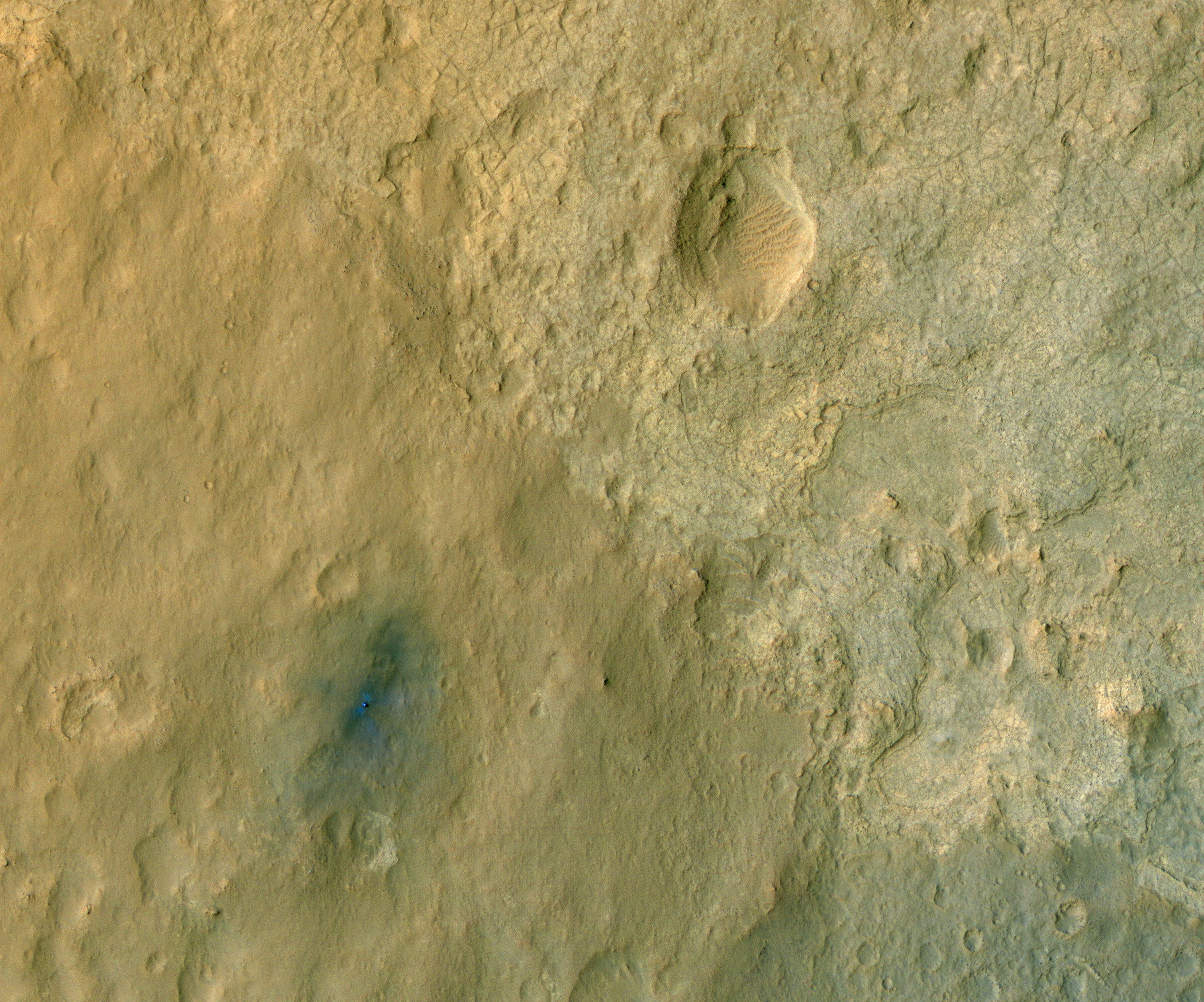
Nasa’s Curiosity Mars rover seen in new satellite image
By Jonathan Amos Science correspondent

The MRO image shows the terrain around the rover (double blue/white dot) at its landing site within Gale Crater on Mars. The blue fans either side are rocket blast marks in the ground
Nasa has used its high-resolution imaging satellite at the Red Planet to look down on the Curiosity rover and acquire a new picture of the recently landed six-wheeled robot.
The vehicle appears as a double dot.
The view from the Mars Reconnaissance Orbiter (MRO) has been colour enhanced to emphasise certain ground features.
These include the disturbance in the soil made either side of the vehicle by the rocket powered crane that lowered Curiosity into Gale Crater a week ago.
“We can clearly see Curiosity – it’s like two bright spots that we see, and their shadows. And then it’s surrounded by the blast pattern from the descent stage – those little blue fans right next to it (false colour blue),” explained Alfred McEwen, the principal investigator on MRO’s High Resolution Image Science Experiment (HiRise) camera.
Read more: http://www.bbc.co.uk/news/science-environment-19262486
CERN’s Large Hadron Collider Experiments Bring New Insight Into Matter of the Primordial Universe
ScienceDaily (Aug. 13, 2012) — Experiments using heavy ions at CERN’s Large Hadron Collider (LHC) are advancing understanding of the primordial Universe. The ALICE, ATLAS and CMS collaborations have made new measurements of the kind of matter that probably existed in the first instants of the Universe. They will present their latest results at the 2012 Quark Matter conference, which starts August 13 in Washington DC. The new findings are based mainly on the four-week LHC run with lead ions in 2011, during which the experiments collected 20 times more data than in 2010.

Just after the Big Bang, quarks and gluons — basic building blocks of matter — were not confined inside composite particles such as protons and neutrons, as they are today. Instead, they moved freely in a state of matter known as ‘quark-gluon plasma’. Collisions of lead ions in the LHC, the world’s most powerful particle accelerator, recreate for a fleeting moment conditions similar to those of the early Universe. By examining a billion or so of these collisions, the experiments have been able to make more precise measurements of the properties of matter under these extreme conditions.
“The field of heavy-ion physics is crucial for probing the properties of matter in the primordial Universe, one of the key questions of fundamental physics that the LHC and its experiments are designed to address. It illustrates how in addition to the investigation of the recently discovered Higgs-like boson, physicists at the LHC are studying many other important phenomena in both proton-proton and lead-lead collisions,” said CERN Director General Rolf Heuer.
Read more: http://www.sciencedaily.com/releases/2012/08/120813115445.htm
Mars Rover Curiosity Sends First Full-Color Panorama of Its New Martian Home
360 degrees of lovely Gale Crater
By Rebecca Boyle Posted 08.09.2012

After a couple days of black-and-white imagery and blurry color thumbnails, the Mars rover Curiosity has downlinked its first full-color, 360-degree view of its new home in Gale Crater. Click past the jump to enlarge the whole thing–it’s incredible.
The image was brightened during its processing, because it’s not actually this sunny on Mars. The planet is another 50-ish million miles from the sun, and it only receives half the sunlight Earth does.
Scientist Discovers Plate Tectonics On Mars
ScienceDaily (Aug. 9, 2012) — For years, many scientists had thought that plate tectonics existed nowhere in our solar system but on Earth. Now, a UCLA scientist has discovered that the geological phenomenon, which involves the movement of huge crustal plates beneath a planet’s surface, also exists on Mars.

“Mars is at a primitive stage of plate tectonics. It gives us a glimpse of how the early Earth may have looked and may help us understand how plate tectonics began on Earth,” said An Yin, a UCLA professor of Earth and space sciences and the sole author of the new research.
Yin made the discovery during his analysis of satellite images from a NASA spacecraft known as THEMIS (Time History of Events and Macroscale Interactions during Substorms) and from the HIRISE (High Resolution Imaging Science Experiment) camera on NASA’s Mars Reconnaissance Orbiter. He analyzed about 100 satellite images — approximately a dozen were revealing of plate tectonics.
Read more: http://www.sciencedaily.com/releases/2012/08/120809155831.htm
Higgs boson results from LHC ‘get even stronger’
August 3, 2012
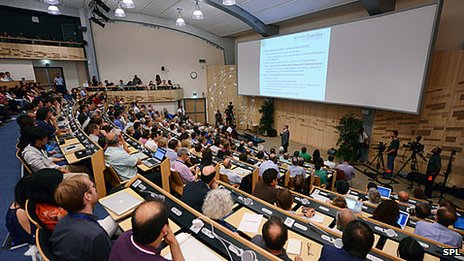
The particle has been the subject of a decades-long hunt as the last missing piece of physics’ Standard Model, explaining why matter has mass.
Now one Higgs-hunting team at the Large Hadron Collider report a “5.9 sigma” levels of certainty it exists.
That equates to a one-in-550 million chance if the Higgs did not exist, the team would see these same results.
The formal threshold for claiming the discovery of a particle is a 5-sigma level – equivalent to a one-in-3.5 million chance.
That is the level that was claimed by the team behind Atlas, one of the LHC’s Higgs-hunting experiments, during the 4 July announcement. The other, known as CMS, claimed results between 4.9 and 5 sigma.
Read more: http://www.bbc.co.uk/news/science-environment-19076355
The Ground-Wave Emergency Network (GWEN) System
Written by Val Valerian
http://educate-yourself.org/dc/gwentowersbybyronweeks.shtml
{Editor’s Note: GWEN towers are popping up everywhere in America; rural, hilltops, mountain areas, suburbs, and cities. The cover story is that they’re supposed to be used for cell phone communications, but as this article reveals, Big Brother has something far more insidious in mind. ..Ken Adachi]
The Ground-Wave Emergency Network (GWEN) is a communications system that the military is in the process of constructing as we speak. It operates in the very-low-frequency (VLF) range, with transmissions between 150 and 175 kHz. This range was selected because its signals travel by means of waves that have a tendency to hug the ground rather than by radiating into the atmosphere. This signal drops off sharply with distance – a single GWEN stations transmits in a 360 circle to a distance of 250 to 300 miles. The entire GWEN system consists of approximately 300 such stations spread across the United States, each with a tower 300-500 feet high. The stations are from 200 to 250 miles apart, so that a signal can go from coast to coast from one station to another. When the system is completed around 1993, the entire civilian population of the United States will be exposed to the GWEN Transmissions. Read Appendix 4 and then re-read this section.
I. APPLICATION OF MILITARY FREQUENCY WEAPONRY
According to a 1982 Air Force review of biotechnology, ELF has a number of potential military uses, including “dealing with terrorist groups, crowd control, controlling breaches of security at military installations, and antipersonnel techniques in tactical warfare.” The same report states:
“Electromagnetic systems would be used to produce mild to severe physiological disruption or perceptual dis- tortion or disorientation. They are silent, and counter- measures to them may be difficult to develop.”
Between 1980 and 1984 I was in England, and I got to see some illustrations of how some of this technology actually works. During this period, there were a lot of protests, sit-ins and demonstrations by Greenpeace and many other groups against the deployment of Cruise missiles, especially at Greenham Common, which was south of where I was located. In 1983 and 1984 there was a very large presence of military police at the base when the Cruise missiles arrived. Around mid-1984 this presence diminished considerably, and some of the protesters who were outside the base started claiming that they were being irradiated from the base because of physical problems they were unable to link to any other source. This was reported in Electronics Todsy magazine in 1985. The symptoms ranged from skin burns to headaches, drowsiness, menstrual bleeding at abnormal times, bouts of temporary paralysis, faulty speech coordination, and in one case circulatory failure severe enough to require hospitalization. Such a complex series of symptoms fits well with severe EM field exposure. The Ministry Of Defence (MOD) denied that any harmful electromagnetic signal was being used against the women, but did not deny that an electromagnetic signal may be in use which, if below lOmW/cm2, would not, under UK guidelines, be officially acknowledged as harmful. In other words, they lied.
Cases of Deliberate Experimentation on Individuals for Military Purposes
In one study over 100 Washington and Oregon state prisoners (recall the discussion of Phase II drug testing in Chapter 5) between 1963 and 1971 had their testicles dosed with radiation to discover what doses would sterilize them. The project was funded by the Atomic Energy Commission at a cost of $1.5 million.
From 1945 to 1947, 18 hospital patients, one of them only five years old, were injected with plutonium to measure how much the body would retain. The injections were represented as “experimental treatments” for the patients’ illnesses. This appalling scheme was reviewed in the British Medical Journal in 1987, where it said that the “redeeming feature of the test was that the results were made available to other countries for their use.”
Read more: http://educate-yourself.org/dc/gwentowersbybyronweeks.shtml
You can find a list of 58 GWEN relay-node sites here: http://www.airforcebase.net/usaf/GWEN_list.html
Wikipedia: http://en.wikipedia.org/wiki/AN/URC-117_Ground_Wave_Emergency_Network
You Think GMO Is Scary? Nano Tech is Here, In Your Store
Tuesday, 31 July 2012

‘Nanotechnology is measured in billionths of a meter, encompassing all aspects of life from food to medicine, clothing, to space. Imagine hundreds of microcomputers on the width of a strand of hair programmed for specific tasks….in your body. Sound good?
Engineering at a molecular level may be a future corporations’ dream come true, however, nano-particles inside your body have few long-term studies especially when linked to health issues. Despite this new huge income-generating field there is a growing body of toxicological information suggesting that nanotechnology when consumed can cause brain damage (as shown in largemouth bass), and therefore should undergo a full safety assessment.’
Read more: You Think GMO Is Scary? Nano Tech is Here, In Your Store
 Believe nothing