Archive
Nasa’s Curiosity Mars rover seen in new satellite image
By Jonathan Amos Science correspondent

The MRO image shows the terrain around the rover (double blue/white dot) at its landing site within Gale Crater on Mars. The blue fans either side are rocket blast marks in the ground
Nasa has used its high-resolution imaging satellite at the Red Planet to look down on the Curiosity rover and acquire a new picture of the recently landed six-wheeled robot.
The vehicle appears as a double dot.
The view from the Mars Reconnaissance Orbiter (MRO) has been colour enhanced to emphasise certain ground features.
These include the disturbance in the soil made either side of the vehicle by the rocket powered crane that lowered Curiosity into Gale Crater a week ago.
“We can clearly see Curiosity – it’s like two bright spots that we see, and their shadows. And then it’s surrounded by the blast pattern from the descent stage – those little blue fans right next to it (false colour blue),” explained Alfred McEwen, the principal investigator on MRO’s High Resolution Image Science Experiment (HiRise) camera.
Read more: http://www.bbc.co.uk/news/science-environment-19262486
CERN’s Large Hadron Collider Experiments Bring New Insight Into Matter of the Primordial Universe
ScienceDaily (Aug. 13, 2012) — Experiments using heavy ions at CERN’s Large Hadron Collider (LHC) are advancing understanding of the primordial Universe. The ALICE, ATLAS and CMS collaborations have made new measurements of the kind of matter that probably existed in the first instants of the Universe. They will present their latest results at the 2012 Quark Matter conference, which starts August 13 in Washington DC. The new findings are based mainly on the four-week LHC run with lead ions in 2011, during which the experiments collected 20 times more data than in 2010.

Just after the Big Bang, quarks and gluons — basic building blocks of matter — were not confined inside composite particles such as protons and neutrons, as they are today. Instead, they moved freely in a state of matter known as ‘quark-gluon plasma’. Collisions of lead ions in the LHC, the world’s most powerful particle accelerator, recreate for a fleeting moment conditions similar to those of the early Universe. By examining a billion or so of these collisions, the experiments have been able to make more precise measurements of the properties of matter under these extreme conditions.
“The field of heavy-ion physics is crucial for probing the properties of matter in the primordial Universe, one of the key questions of fundamental physics that the LHC and its experiments are designed to address. It illustrates how in addition to the investigation of the recently discovered Higgs-like boson, physicists at the LHC are studying many other important phenomena in both proton-proton and lead-lead collisions,” said CERN Director General Rolf Heuer.
Read more: http://www.sciencedaily.com/releases/2012/08/120813115445.htm
Higgs boson results from LHC ‘get even stronger’
August 3, 2012
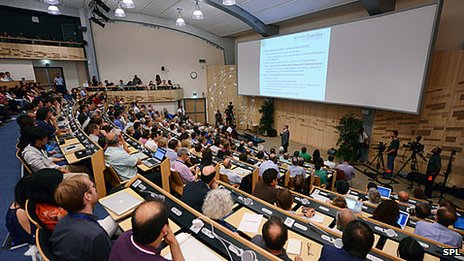
The particle has been the subject of a decades-long hunt as the last missing piece of physics’ Standard Model, explaining why matter has mass.
Now one Higgs-hunting team at the Large Hadron Collider report a “5.9 sigma” levels of certainty it exists.
That equates to a one-in-550 million chance if the Higgs did not exist, the team would see these same results.
The formal threshold for claiming the discovery of a particle is a 5-sigma level – equivalent to a one-in-3.5 million chance.
That is the level that was claimed by the team behind Atlas, one of the LHC’s Higgs-hunting experiments, during the 4 July announcement. The other, known as CMS, claimed results between 4.9 and 5 sigma.
Read more: http://www.bbc.co.uk/news/science-environment-19076355
Gliese 581g – The most habitable exoplanet
 |
This artist’s conception shows the inner four planets of the Gliese 581 system and their host star. The large planet in the foreground is Gliese 581g, which is in the middle of the star’s habitable zone and is only two to three times as massive as Earth. Some researchers aren’t convinced Gliese 581g exists, however.
CREDIT: Lynette Cook
The controversial exoplanet Gliese 581g is the best candidate to host life beyond our own solar system, according to a new ranking of potentially habitable alien worlds.
Gliese 581g shot to the top of the list — which was published Thursday (July 19) by researchers at the University of Puerto Rico at Arecibo’s Planetary Habitability Laboratory (PHL) — after a new study marshaled support for its long-debated existence.
The exoplanet was discovered in September 2010, but other astronomers began casting doubt on its existence just weeks later. Now Gliese 581g’s discoverers have rebutted their critics’ charges in a new paper, and have done so effectively enough to get the PHL onboard.
Read more: http://www.space.com/16722-top-5-habitable-alien-planets.html
Solar Corona Revealed in Super-High-Definition
ScienceDaily (July 20, 2012) — Astronomers have just released the highest-resolution images ever taken of the Sun’s corona, or million-degree outer atmosphere, in an extreme-ultraviolet wavelength of light. The 16-megapixel images were captured by NASA’s High Resolution Coronal Imager, or Hi-C, which was launched on a sounding rocket on July 11th. The Hi-C telescope provides five times more detail than the next-best observations by NASA’s Solar Dynamics Observatory.

These photos of the solar corona, or million-degree outer atmosphere, show the improvement in resolution offered by NASA’s High Resolution Coronal Imager, or Hi-C (bottom), versus the Atmospheric Imaging Assembly on NASA’s Solar Dynamics Observatory (top). Both images show a portion of the sun’s surface roughly 85,000 by 50,000 miles in size. Hi-C launched on a sounding rocket on July 11, 2012 in a flight that lasted about 10 minutes. The representative-color images were made from observations of ultraviolet light at a wavelength of 19.3 nanometers (25 times shorter than the wavelength of visible light). (Credit: NASA)
“Even though this mission was only a few minutes long, it marks a big breakthrough in coronal studies,” said Smithsonian astronomer Leon Golub (Harvard-Smithsonian Center for Astrophysics), one of the lead investigators on the mission.
Understanding the Sun’s activity and its effects on Earth’s environment was the critical scientific objective of Hi-C, which provided unprecedented views of the dynamic activity and structure in the solar atmosphere.
Read more: http://www.sciencedaily.com/releases/2012/07/120720195519.htm
WISE Captures a Nebula on Fire
Sunday July 8, 2012

The Flame Nebula sits on the eastern hip of Orion the Hunter, a constellation most easily visible in the northern hemisphere during winter evenings. Image Credit: NASA/JPL-Caltech
(Phys.org) — A new image from NASA’s Wide-field Infrared Survey Explorer, or WISE, shows the candle-like Flame nebula lighting up a cavern of dust. The Flame nebula is part of the Orion complex, a turbulent star-forming area located near the constellation’s star-studded belt.
The image is being released today along with a new batch of data from the mission. Last March, WISE released its all-sky catalog and atlas containing infrared images and data on more than a half billion objects, including everything from asteroids to stars and galaxies. Now, the mission is offering up additional data from its second scan of the sky.
“If you’re an astronomer, then you’ll probably be in hog heaven when it comes toinfrared data,” said Edward (Ned) Wright of UCLA, the principal investigator of the WISE mission. “Data from the second sky scan are useful for studying stars that vary or move over time, and for improving and checking data from the first scan.”
Read more: http://phys.org/news/2012-07-flame-bright-wise-image.html
In a Cosmology Breakthrough, Astronomers Measure a Filament of Dark Matter
By Rebecca Boyle 07.05.2012

Invisible, cold dark matter plays a major role in the evolution of galaxies, according to modern cosmological theory. The most advanced simulations of cosmic evolution show stringy tendrils of mass — dark matter — connecting giant clusters of galaxies via a vast cosmic web. Now for the first time, astronomers have been able to detect one of these filaments, sussing out its location by watching it warp light.
Strength in Numbers: Physicists Identify New Quantum State Allowing Three — But Not Two — Atoms to Stick Together
July 4, 2012
ScienceDaily (July 3, 2012) — A Kansas State University-led quantum mechanics study has discovered a new bound state in atoms that may help scientists better understand matter and its composition.

The yet-unnamed bound state, which the physicists simply refer to as “our state” in their study, applies to three identical atoms loosely bound together — a behavior called three-body bound states in quantum mechanics. In this state, three atoms can stick together in a group but two cannot. Additionally, in some cases, the three atoms can stick together even when any two are trying to repel each other and break the connection.
“It’s really counterintuitive because not only is the pair interaction too weak to bind two atoms together, it’s also actively trying to push the atoms apart, which is clearly not the goal when you want things to stick together,” said Brett Esry, university distinguished professor of physics at Kansas State University and the study’s lead investigator.
Read more : http://www.sciencedaily.com/releases/2012/07/120703142515.htm
Higgs boson: scientists 99.999% sure ‘God Particle’ has been found
July 4, 2012
Scientists believe they have captured the elusive “God particle” that gives matter mass and holds the physical fabric of the universe together.

The historic announcement came in a progress report from the Large Hadron Collider particle accelerator.
Professor John Womersley, chief executive of the Science and technology Facilities Council, told reporters at a briefing in London: “They have discovered a particle consistent with the Higgs boson.
“Discovery is the important word. That is confirmed. It’s a momentous day for science.”
Scientists say it is a 5 sigma result which means they are 99.999% sure they have found a new particle.
Finding the Higgs plugs a gaping hole in the Standard Model, the theory that describes all the particles, forces and interactions that make up the universe.
Watch Live: Higgs Boson Announcement
July 4, 2012
http://www.wired.com/wiredscience/2012/07/watch-live-higgs-talk/
Officials at CERN will finally be revealing their latest results in the search for the Higgs boson during a talk starting at midnight PT (3 a.m. ET) on July 4.
Physicists have been eagerly waiting for this announcement, with hopes running high that the new data will pin down Higgs boson with enough precision to consider it discovered. Previously, LHC results have strongly signaled the existence of a Higgs with a mass of 125 gigaelectronvolts (GeV), or roughly 125 times more massive than the proton. More recently, rumors have been flying that suggest this talk will be the definitive announcement of the long-sought boson’s discovery.
Read more : http://www.wired.com/wiredscience/2012/07/watch-live-higgs-talk/
 Believe nothing