Archive
WISE survey uncovers millions of black holes

With its all-sky infrared survey, NASA’s Wide-field Infrared Survey Explorer, or WISE, has identified millions of quasar candidates. Image credit: NASA/JPL-Caltech/UCLA
(Phys.org)—NASA’s Wide-field Infrared Survey Explorer (WISE) mission has led to a bonanza of newfound supermassive black holes and extreme galaxies called hot DOGs, or dust-obscured galaxies.
Images from the telescope have revealed millions of dusty black hole candidates across the universe and about 1,000 even dustier objects thought to be among the brightest galaxies ever found. These powerful galaxies, which burn brightly with infrared light, are nicknamed hot DOGs.
“WISE has exposed a menagerie of hidden objects,” said Hashima Hasan, WISE program scientist at NASA Headquarters in Washington. “We’ve found an asteroid dancing ahead of Earth in its orbit, the coldest star-like orbs known and now, supermassive black holes and galaxies hiding behind cloaks of dust.”
WISE scanned the whole sky twice in infrared light, completing its survey in early 2011. Like night-vision goggles probing the dark, the telescope captured millions of images of the sky. All the data from the mission have been released publicly, allowing astronomers to dig in and make new discoveries.
Read more: http://phys.org/news/2012-08-wise-survey-uncovers-millions-black.html
NASA’s Kepler Discovers Multiple Planets Orbiting a Pair of Stars
ScienceDaily (Aug. 28, 2012) — Coming less than a year after the announcement of the first circumbinary planet, Kepler-16b, NASA’s Kepler mission has discovered multiple transiting planets orbiting two suns for the first time. This system, known as a circumbinary planetary system, is 4,900 light-years from Earth in the constellation Cygnus.

This discovery proves that more than one planet can form and persist in the stressful realm of a binary star and demonstrates the diversity of planetary systems in our galaxy.
Astronomers detected two planets in the Kepler-47 system, a pair of orbiting stars that eclipse each other every 7.5 days from our vantage point on Earth. One star is similar to the sun in size, but only 84 percent as bright. The second star is diminutive, measuring only one-third the size of the sun and less than 1 percent as bright.
Read more: http://www.sciencedaily.com/releases/2012/08/120828190127.htm
NASA Rover Returns Voice, Telephoto Views From Mars
August 28, 2012
 A chapter of the layered geological history of Mars is laid bare in this postcard from NASA’s Curiosity rover. The image shows the base of Mount Sharp, the rover’s eventual science destination. Image credit: NASA/JPL-Caltech/MSSS
PASADENA, Calif. — NASA’s Mars Curiosity has debuted the first recorded human voice that traveled from Earth to another planet and back.
In spoken words radioed to the rover on Mars and back to NASA’s Deep Space Network (DSN) on Earth, NASA Administrator Charles Bolden noted the difficulty of landing a rover on Mars, congratulated NASA employees and the agency’s commercial and government partners on the successful landing of Curiosity earlier this month, and said curiosity is what drives humans to explore.
“The knowledge we hope to gain from our observation and analysis of Gale Crater will tell us much about the possibility of life on Mars as well as the past and future possibilities for our own planet. Curiosity will bring benefits to Earth and inspire a new generation of scientists and explorers, as it prepares the way for a human mission in the not too distant future,” Bolden said in the recorded message.
The voice playback was released along with new telephoto camera views of the varied Martian landscape during a news conference today at NASA’s Jet Propulsion Laboratory, Pasadena, Calif.
Read more: http://www.nasa.gov/mission_pages/msl/news/msl20120827.html
› Full image and caption › Latest images › Curiosity gallery › Curiosity videos
Curiosity landing video assembled from high-res images (video)

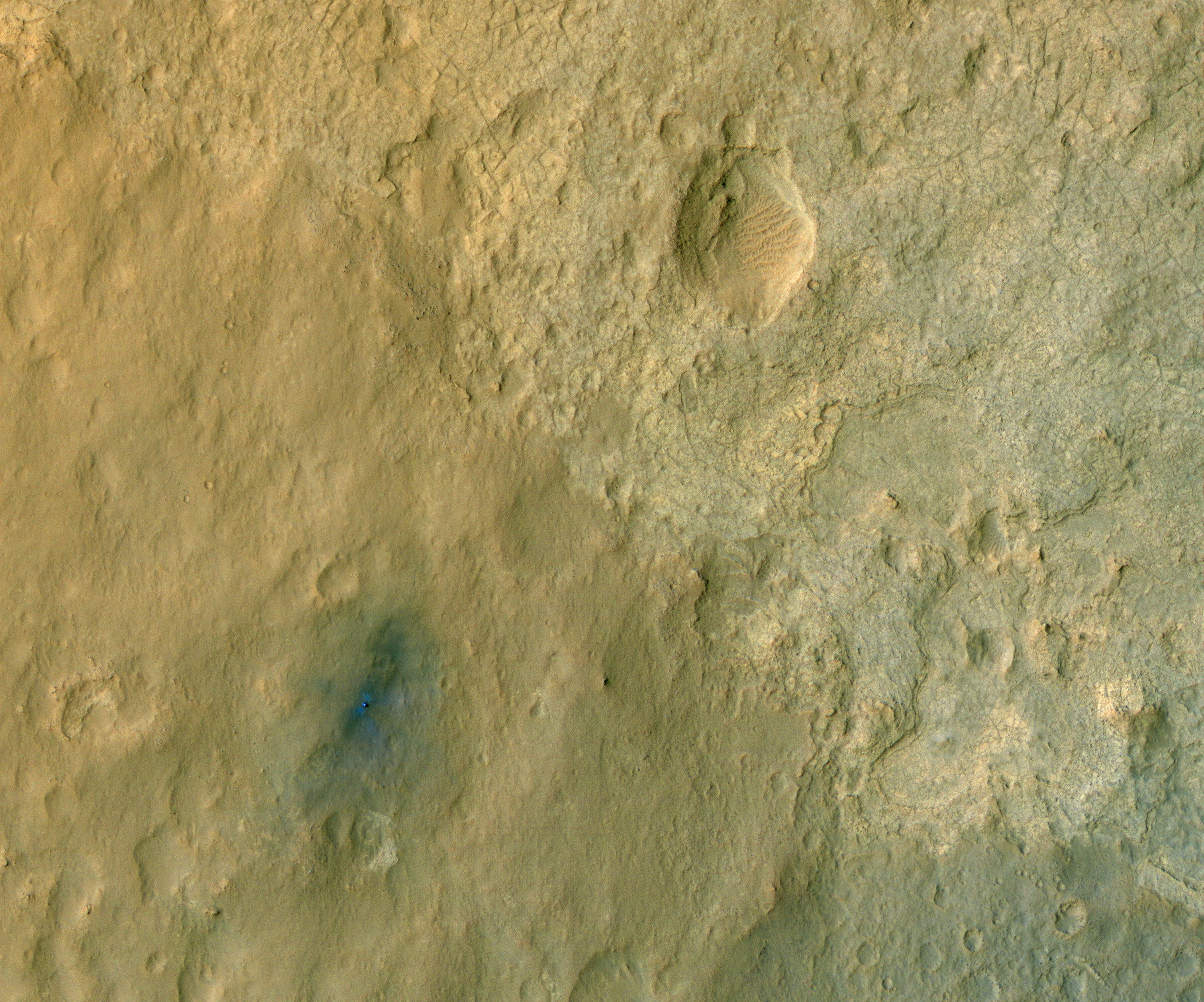
Nasa’s Curiosity Mars rover seen in new satellite image
By Jonathan Amos Science correspondent

The MRO image shows the terrain around the rover (double blue/white dot) at its landing site within Gale Crater on Mars. The blue fans either side are rocket blast marks in the ground
Nasa has used its high-resolution imaging satellite at the Red Planet to look down on the Curiosity rover and acquire a new picture of the recently landed six-wheeled robot.
The vehicle appears as a double dot.
The view from the Mars Reconnaissance Orbiter (MRO) has been colour enhanced to emphasise certain ground features.
These include the disturbance in the soil made either side of the vehicle by the rocket powered crane that lowered Curiosity into Gale Crater a week ago.
“We can clearly see Curiosity – it’s like two bright spots that we see, and their shadows. And then it’s surrounded by the blast pattern from the descent stage – those little blue fans right next to it (false colour blue),” explained Alfred McEwen, the principal investigator on MRO’s High Resolution Image Science Experiment (HiRise) camera.
Read more: http://www.bbc.co.uk/news/science-environment-19262486
Cassini sees tropical lakes on Saturn moon

Where could the liquid for these lakes come from? “A likely supplier is an underground aquifer,” said Caitlin Griffith from the University of Arizona in Tucson. “In essence, Titan may have oases.”
Understanding how lakes or wetlands form on Titan helps scientists learn about the moon’s weather. Like Earth’s hydrological cycle, Titan has a “methane cycle,” with methane rather than water circulating. In Titan’s atmosphere, ultraviolet light breaks apart methane, initiating a chain of complicated organic chemical reactions. But existing models haven’t been able to account for the abundant supply of methane.
“An aquifer could explain one of the puzzling questions about the existence of methane, which is continually depleted,” Griffith said. “Methane is a progenitor of Titan’s organic chemistry, which likely produces interesting molecules like amino acids, the building blocks of life.”
Global circulation models of Titan have theorized that liquid methane in the moon’s equatorial region evaporates and is carried by wind to the north and south poles, where cooler temperatures cause methane to condense. When it falls to the surface, it forms the polar lakes. On Earth, water is similarly transported by the circulation, yet the oceans also transport water, thereby countering the atmospheric effects.
The latest results come from Cassini’s visual and infrared mapping spectrometer, which detected the dark areas in the tropical region known as Shangri-La, near the spot where the European Space Agency’s Huygens probe landed in 2005. When Huygens landed, the heat of the probe’s lamp vaporized some methane from the ground, indicating it had landed in a damp area.
Areas appear dark to the visual and infrared mapping spectrometer when liquid ethane or methane is present. Some regions could be ankle-deep puddles. Cassini’s radar mapper has seen lakes in the polar region but hasn’t detected any lakes at low latitudes.
The tropical lakes detected by the visual and infrared mapping spectrometer have remained since 2004. Only once has rain been detected falling and evaporating in the equatorial regions, and only during the recent expected rainy season. Scientists therefore deduce that the lakes could not be substantively replenished by rain.
“We had thought that Titan simply had extensive dunes at the equator and lakes at the poles, but now we know that Titan is more complex than we previously thought,” said Linda Spilker from NASA’s Jet Propulsion Laboratory in Pasadena, California. “Cassini still has multiple opportunities to fly by this moon going forward, so we can’t wait to see how the details of this story fill out.”
 Believe nothing