Archive
James Cameron, Charles Simonyi, and Ross Perot, Jr. to Unveil Space Project
By Dan Nosowitz Posted 04.20.2012 at 5:30 pm

Planetary Resources, a mysterious organization whose investors include Google execs Larry Page and Eric Schmidt, Microsoft alum and astronaut Charles Simonyi, director James Cameron, “space visionary” Peter Diamandis, and Ross Perot, Jr., is planning to announce more details of the project this coming Tuesday. We’ll be covering it, so we thought we’d give you a heads-up. It has something to do with space resources and exploration–its LinkedIn page says it “develops technologies and systems to enable low-cost commercial robotic exploration of the solar system,” and cofounder Peter Diamandis has hinted at asteroid mining–but we don’t know much more than that at the moment. Check in here on Tuesday (and, I mean, on Monday too, for other things) for the reveal.
Our Universe Is A Gigantic And Wonderfully Detailed Holographic Illusion

‘In our daily life we are not aware that we may, in fact, live in a hologram and our existence is a holographic projection, nothing more. All what we believe is real, our whole physical world, is – in fact – an illusion being proved by the holographic universe, one of the most remarkable theories of 20th century.
Energy fields are decoded by our brains into a 3D picture, to give the illusion of a physical world. Despite its apparent materiality, the universe is a kind of 3-D projection and is ultimately no more real than a hologram.
“Our brain mathematically construct objective reality by interpreting frequencies that are ultimately from another dimension, a deeper order of existence that is beyond both space and time.’
Read more: Our Universe Is A Gigantic And Wonderfully Detailed Holographic Illusion
XNA is synthetic DNA that’s stronger than the real thing
By Robert T. Gonzalez
http://io9.com/5903221/meet-xna-the-first-synthetic-dna-that-evolves-like-the-real-thing

New research has brought us closer than ever to synthesizing entirely new forms of life. An international team of researchers has shown that artificial nucleic acids – called “XNAs” – can replicate and evolve, just like DNA and RNA.
We spoke to one of the researchers who made this breakthrough, to find out how it can affect everything from genetic research to the search for alien life.
World’s First Handmade Cloned Transgenic Sheep Born in China

Chinese scientists from BGI, the world’s largest genomics organization, together with the Institute of Genetics and Developmental Biology, Chinese Academy of Sciences (CAS), and Shihezi University, Xinjiang province, made a significant breakthrough in animal cloning. The world’s first transgenic sheep produced with a simplified technique, handmade cloning, was successfully born at 12:16pm, March 26, 2012, in Xinjiang Uygur Autonomous Region, China. The project was also supported by the Animal Science Academy of Xinjiang.
Mandatory ‘Big Brother’ Black Boxes In All New Cars From 2015
Thursday, 19 April 2012 08:51

‘A bill already passed by the Senate and set to be rubber stamped by the House would make it mandatory for all new cars in the United States to be fitted with black box data recorders from 2015 onwards.
Section 31406 of Senate Bill 1813 (known as MAP-21), calls for “Mandatory Event Data Recorders” to be installed in all new automobiles and legislates for civil penalties to be imposed against individuals for failing to do so.’
Read more: Mandatory ‘Big Brother’ Black Boxes In All New Cars From 2015
Nanoparticle Coating Makes Paper Magnetic, Waterproof, and Antibacterial
By Rebecca Boyle Posted 04.18.2012 at 4:28 pm

Scientists at the Istituto Italiano di Tecnologia in Genoa, Italy, developed a process to cover any cellulose fiber, like paper or fabric, with a reactive coating. It involves combining the fiber molecules with a nanoparticle solution, creating a polymer matrix.
A Visual Tour of the Fuel Pools of Fukushima
Do You Know What the Fuel Pools Actually Look Like?
You already know that Fukushima’s fuel pool number 4 may be the single greatest threat, but that pool number 3 is very dangerous as well.
You’ve heard that unit 3′s fuel pool contains less radioactive material than unit 4 … but still a tremendous amount of radiation. Scientific American reported last year:
The pools at each reactor are thought to have contained the following amounts of spent fuel, according to The Mainichi Daily News:
• Reactor No. 1: 50 tons of nuclear fuel
• Reactor No. 2: 81 tons
• Reactor No. 3: 88 tons
• Reactor No. 4: 135 tons
• Reactor No. 5: 142 tons
• Reactor No. 6: 151 tons
• Also, a separate ground-level fuel pool contains 1,097 tons of fuel; and some 70 tons of nuclear materials are kept on the grounds in dry storage.
You’ve learned that unit 3′s reactor was the only one at Fukushima which burned plutonium. As Japan Times notes:
Reactor 3 … uses highly dangerous mixed oxide fuel, Tokyo Electric has reported.
***
No. 3 reactor is the only one at the crippled power station that was powered by the plutonium-uranium MOX
You’ve gotten the fact that – if the water drains out for any reason – it will cause a fire in the fuel rods, as the zirconium metal jacket on the outside of the fuel rods could very well catch fire within hours or days after being exposed to air. See this, this, this and this. (And that even a large solar flare could knock out the water-circulation systemsfor the pools.)
You’ve listened to experts say that – unless the rods are removed from the fuel pools before a major earthquake strikes (using special equipment which keeps the rods submerged in water the whole time) – they will likely catch fire and release huge amounts of radioactivity. See this and this – starting at 4 minutes into the video.
You’ve read that – after reviewing photos from several different angles – the Nuclear Regulatory Commission’s initial impressions were that spent fuel pool number 3 might not be there at all, and that nuclear engineer Arnie Gundersen said a couple of days ago:
Unit 3 is worse [than No. 4]. It’s mechanically its rubble, the pool is rubble. It’s got less fuel in it. It faces the same problem. Structurally the pool has been dramatically weakened. And, god nobody has even gotten near it yet.
And you may caught the recent headline that a 35-ton machine fell into spent fuel pool 3. As Kyodo News reports:
The operator of the crippled Fukushima Daiichi nuclear power plant on Friday found that a 35-ton machine had dropped inside the spent fuel pool of the No. 3 unit, possibly because of a hydrogen explosion that occurred in the early stage of plant’s nuclear accident last year.
Tokyo Electric Power Co., commonly known as TEPCO, reported the finding after placing a camera inside the water-filled pool the same day to prepare for removing, as part of the decommissioning process, the nuclear fuel stored there.
One photo showed part of the machine, originally located above the pool and used to insert and remove fuel, appeared to have dropped onto the nuclear fuel storage racks.
But – until you see pictures – it is hard to get a sense of what all this means.
Here’s a picture just released by Tepco of the giant machine in the fuel pool :

And another new Tepco photo showing other tangled wreckage inside the pool:

The following graphics from Ashai news show how the crane is normally used to move spent fuel rods in and out of the pool. Here’s the crane bringing in a special container to hold the rods:
Loading spent fuel rods into the container:
The crane then lifts the rod-carrying container up:
And then away from the pool:
Keep in mind that the machine which fell into pool number 3 was part of the crane “used to insert and remove fuel”, and so now there is no easy way to remove the fuel from the fuel pool. And the crane at unit 4 is also broken:
Still confused?
Let’s look at some more pictures …
Before the Quake
Here is where the fuel pools are located in the Fukushima reactors:

Here are pictures Unit 3′s fuel pool before the earthquake, and the fuel pool crane:



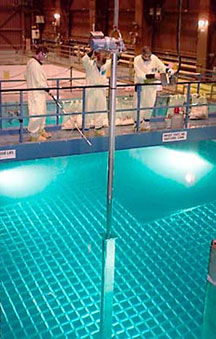

This shot is during repairs at reactor 4 before the earthquake – but gives a sense of scale:

After the Quake
Here is the green fuel pool crane at unit 4 after the earthquake:

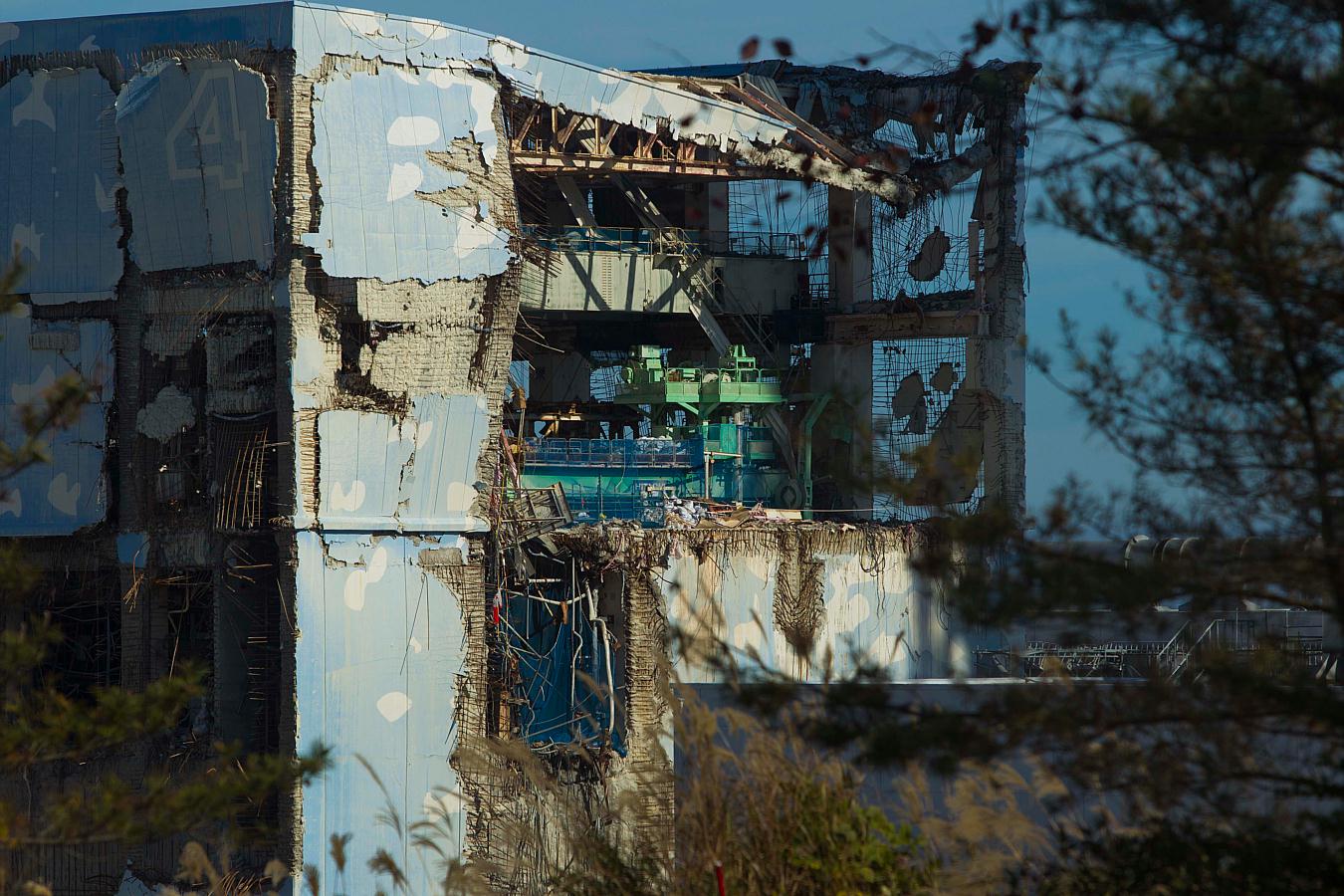


The view from above the crane at fuel pool 4:


(“SFP” in these photos refers to the spent fuel pool.)
Former fuel pool nuclear engineer Arnie Gundersen notes that – for at least some period after the earthquake – the fuel pool had insufficient water, and the nuclear rods were sticking out into the air:
Here is water later being poured into fuel pool 4:
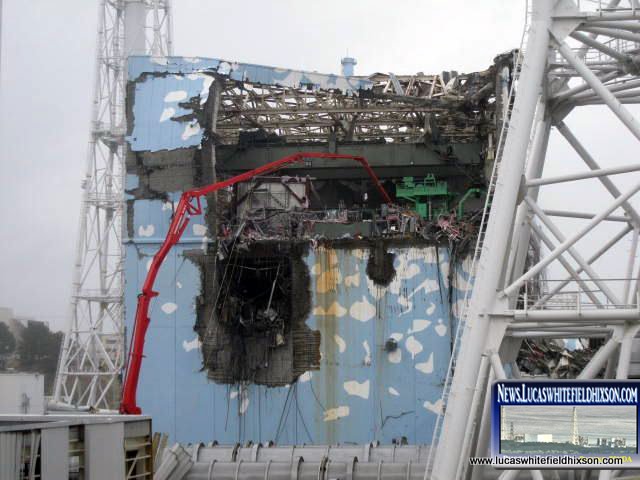
Reactor 3 is a mess:


HouseofOust notes of this picture:
Oval is the reactor well location. Lines on the left side of the image outline the crane that seems to have fallen over or been crushed. Spent fuel pool outlined in the foreground.

And of this picture:
Perspective lines are drawn to show where the deck should be and how much is gone. A circle shows the beam apex to appoximate the reactor well. Spent fuel pool is again seen off to the right and outlined. Marked structure in the foreground is the end of the refueling crane.

Now can you see what’s going on?
Penguins, Polar Bears, Glaciers, Arctic Ice All Thriving
Tuesday, 17 April 2012 09:58

‘Even as climate alarmists amplify their call for a worldwide tax on carbon dioxide emissions in the name of preventing global warming – penguins, polar bears, Himalayan glaciers and Arctic sea ice are all thriving.
With dire proclamations of ice free Arctic summers vehemently debunked, the latest data indicates that both wildlife and the environment in earth’s coldest regions has not experienced the catastrophic devastation predicted as a result of man-made climate change.’
Read more: Penguins, Polar Bears, Glaciers, Arctic Ice All Thriving
http://www.sciencedaily.com/releases/2012/04/120413145303.htm
http://www.theregister.co.uk/2012/04/11/bering_sea_ice_cover/
First Phobos, now Mars too has a monolith.
By Natalie Wolchover | LiveScience.com – Wed, Apr 11, 2012
http://news.yahoo.com/monolith-object-mars-could-call-214004772.html
discuss at: http://forum.davidicke.com/showthread.php?t=206925

Amateur stargazers have discovered an intriguing object jutting out from the surface of Mars. The seemingly perfectly rectangular, upright structure, found in NASA images of the Red Planet, bears a striking resemblance to the monoliths planted on Earth and the moon by aliens in the classic sci-fi film “2001: A Space Odyssey.”
The object in question was first spotted several years ago after being photographed by the HiRISE camera onboard the Mars Reconnaissance Orbiter, a NASA space probe; every so often, it garners renewed interest on the Internet. But is it unnatural — a beacon erected by aliens for mysterious reasons, and even more mysteriously paralleled in the imaginations of Stanley Kubrick and Arthur C. Clarke, creators of “2001”? Or is this rock the work of nature?
According to Jonathon Hill, a research technician and mission planner at the Mars Space Flight Facility at Arizona State University, who processes many of the images taken during NASA’s Mars missions, the object in question is no more than a roughly rectangular boulder.
The HiRISE camera that photographed it has a resolution of approximately 1 foot (30 centimeters) per pixel — impressive considering the 180-mile (300-kilometer) altitude from which it photographs the Martian surface, but not quite sharp enough to capture the cragginess of a mid-size boulder. “When your resolution is too low to fully resolve an object, it tends to look rectangular because the pixels in the image are squares. Any curve will look like a series of straight lines if you reduce your resolution enough,” Hill told Life’s Little Mysteries.
The location of the boulder at the bottom of a cliff near many other boulders suggests it broke off the cliff and tumbled to its current spot sometime in the distant past, Hill said. Such a perilous location is itself an argument against deliberate placement by aliens: “If I was going to build a monolith somewhere, that’s the last place I would put it!” he said. “The debris falling from the cliff would cover it up pretty quickly, on geologic timescales.”
Hill added that the height of the boulder is being exaggerated in the photo by a low sun angle. Photographed when the sun was near the horizon, the boulder casts an especially long shadow.
The ufologists aren’t necessarily wrong in calling it a monolith — the word simply translates from Latin as “one stone.” But this monolith isn’t the masonry of Martians.


North Korea rocket launch fails
http://www.bbc.co.uk/news/world-asia-17698438
 North Korea says the rocket was planned to put a satellite into orbit
The rocket – seen by many as a banned test of long-range missile technology – was launched from north-west North Korea early on Friday.
The US, Japan and South Korea say it flew only for a short time before breaking up and crashing into waters off the Korean peninsula.
North Korea said its scientists were assessing what had caused the failure.
North Korea says the aim of the rocket was to launch a satellite into orbit – a move marking the 100th anniversary of the birth of national founder Kim Il-sung.
But the US and other nations say the launch constituted a disguised test of long-range missile technology banned under UN resolutions.
In a statement, the White House condemned the launch, despite its failure. The UN Security Council is due to meet later in the day to discuss the launch. China, North Korea’s closest ally, has called for calm and restraint on the Korean peninsula.
‘Ended in failure’
The rocket went up at 07:39 local time (22:39 GMT Thursday), South Korean officials said.
Its intended flight path would have taken it south, to the west of the Korean peninsula between Japan and the Philippines.
But officials from several nations observing the launch said the rocket had failed.
“Start Quote
North Korea’s launch… is a clear breach of the UN resolution that prohibits any launch using ballistic missile technology ”
End Quote Kim Sung-hwan South Korean Foreign Minister
“Initial indications are that the first stage of the missile fell into the sea 165km (105 miles) west of Seoul, South Korea,” the North American Aerospace Defense Command (Norad) said in a statement.
“The remaining stages were assessed to have failed and no debris fell on land. At no time were the missile or the resultant debris a threat.”
Japan reported similar details.
“At approximately 07:40 we confirmed that a certain flying object was launched from North Korea and fell after flying for just over a minute,” Japanese Defence Minister Naoki Tanaka said.
South Korea said the rocket exploded into some 20 pieces and fell into the sea.
“We are conducting a search operation to retrieve the fallen objects,” a defence ministry official said.
Some five hours after the launch, North Korea confirmed it had been unsuccessful.
“The Earth observation satellite failed to enter its preset orbit. Scientists, technicians and experts are now looking into the cause of the failure,” state-run KCNA news agency said. State television carried a similar announcement.
The BBC’s Damian Grammaticas, who is one of a number of foreign journalists invited into North Korea for the launch, said the group had not been given any more information beyond that brief statement.
The rocket’s failure, our correspondent said, is an embarrassment for the North Korean leadership.
It will also come, analysts say, as a relief to many countries who are worried about North Korea’s potential to deliver weapons via long-range missiles.
‘Provocative action’
The US said that North Korea’s behaviour was of concern to the global community.
 Kim Jong-un inherited the North Korean leadership in December 2011
“Despite the failure of its attempted missile launch, North Korea’s provocative action threatens regional security, violates international law and contravenes its own recent commitments,” a White House statement said.
Pyongyang agreed in February to a partial freeze in nuclear activities and a missile test moratorium in return for US food aid. But that deal was put on hold last month after the North announced its rocket launch plans.
Earlier this week reports also emerged from South Korea of a possible third nuclear test being planned by North Korea.
North Korea conducted a similar rocket launch in 2009. On that occasion US and South Korea analysts said the rocket failed to reach orbit – but North Korea said it was a success.
The failure of this launch could pose a challenge for Pyongyang, which is holding a week of high-profile events ahead of the formal celebrations to mark Kim Il-sung’s birthday on Sunday.
The Workers’ Party held a rare conference on Wednesday and the country’s rubber-stamp parliament is due to meet on Friday.
Both meetings are seen as formalising the transition of power to young leader Kim Jong-un following the death of his father Kim Jong-il in December 2011.
 Believe nothing