Don`t think like me

Think about it

Conformity

You don`t need

The budget

It takes everything

You`re about to learn something

The door is open

Giant storms on Saturn: Nasa captures incredible view of ‘rose’ hurricane 20 times bigger than any on Earth
- Hurricane’s eye is about 1,250 miles (2,000 kilometers) wide, 20 times larger than the average hurricane eye on Earth
- Hurricane swirls inside a large, mysterious, six-sided weather pattern known as the hexagon
By MARK PRIGG
PUBLISHED: 17:40 GMT, 29 April 2013 | UPDATED: 18:49 GMT, 29 April 2013
At first glance, it resembles a giant rose, surrounded by green foliage.
However, in fact this is a huge, violent storm of the surface of Saturn – and one that has been brewing for years
In high-resolution pictures and video, scientists say the hurricane’s eye is about 1,250 miles (2,000 kilometers) wide, 20 times larger than the average hurricane eye on Earth.
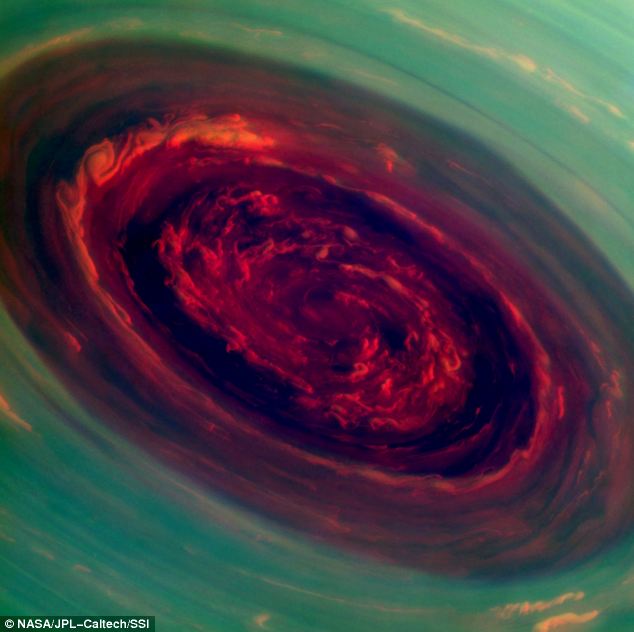 The spinning vortex of Saturn’s north polar storm resembles a deep red rose of giant proportions surrounded by green foliage in this false-color image from NASA’s Cassini spacecraft. Measurements have sized the eye at a staggering 1,250 miles (2,000 kilometers) across with cloud speeds as fast as 330 miles per hour (150 meters per second).
Thin, bright clouds at the outer edge of the hurricane are traveling 330 mph(150 meters per second). The hurricane swirls inside a large, mysterious, six-sided weather pattern known as the hexagon.
‘We did a double take when we saw this vortex because it looks so much like a hurricane on Earth,’ said Andrew Ingersoll, a Cassini imaging team member at the California Institute of Technology in Pasadena.
‘But there it is at Saturn, on a much larger scale, and it is somehow getting by on the small amounts of water vapor in Saturn’s hydrogen atmosphere.’
Scientists will be studying the hurricane to gain insight into hurricanes on Earth, which feed off warm ocean water.
Scientists Detect ‘Dark Lightning’ Energy Burst Linked to Visible Lightning
Apr. 24, 2013 — Researchers have identified a burst of high-energy radiation known as ‘dark lightning” immediately preceding a flash of ordinary lightning. The new finding provides observational evidence that the two phenomena are connected, although the exact nature of the relationship between ordinary bright lightning and the dark variety is still unclear, the scientists said.

“Our results indicate that both these phenomena, dark and bright lightning, are intrinsic processes in the discharge of lightning,” said Nikolai Østgaard, who is a space scientist at the University of Bergen in Norway and led the research team.
He and his collaborators describe their findings in an article recently accepted in Geophysical Research Letters — a journal of the American Geophysical Union.
Dark lightning is a burst of gamma rays produced during thunderstorms by extremely fast moving electrons colliding with air molecules. Researchers refer to such a burst as a terrestrial gamma ray flash.
Read more:http://www.sciencedaily.com/releases/2013/04/130424210319.htm
 Believe nothing