Archive
Milky Way Now Has a Twin (or Two): Astronomers Find First Group of Galaxies Just Like Ours
ScienceDaily (Aug. 22, 2012) — Research presented Aug. 23, 2012 at the International Astronomical Union General Assembly in Beijing has found the first group of galaxies that is just like ours, a rare sight in the local Universe.

The Milky Way is a fairly typical galaxy on its own, but when paired with its close neighbours — the Magellanic Clouds — it is very rare, and could have been one of a kind, until a survey of our local Universe found another two examples just like us.
Astronomer Dr Aaron Robotham, jointly from the University of Western Australia node of the International Centre for Radio Astronomy Research (ICRAR) and the University of St Andrews in Scotland, searched for groups of galaxies similar to ours in the most detailed map of the local Universe yet, the Galaxy and Mass Assembly survey (GAMA).
“We’ve never found another galaxy system like the Milky Way before, which is not surprising considering how hard they are to spot! It’s only recently become possible to do the type of analysis that lets us find similar groups,” says Dr Robotham.
Read more: http://www.sciencedaily.com/releases/2012/08/120822221342.htm
Curiosity landing video assembled from high-res images (video)

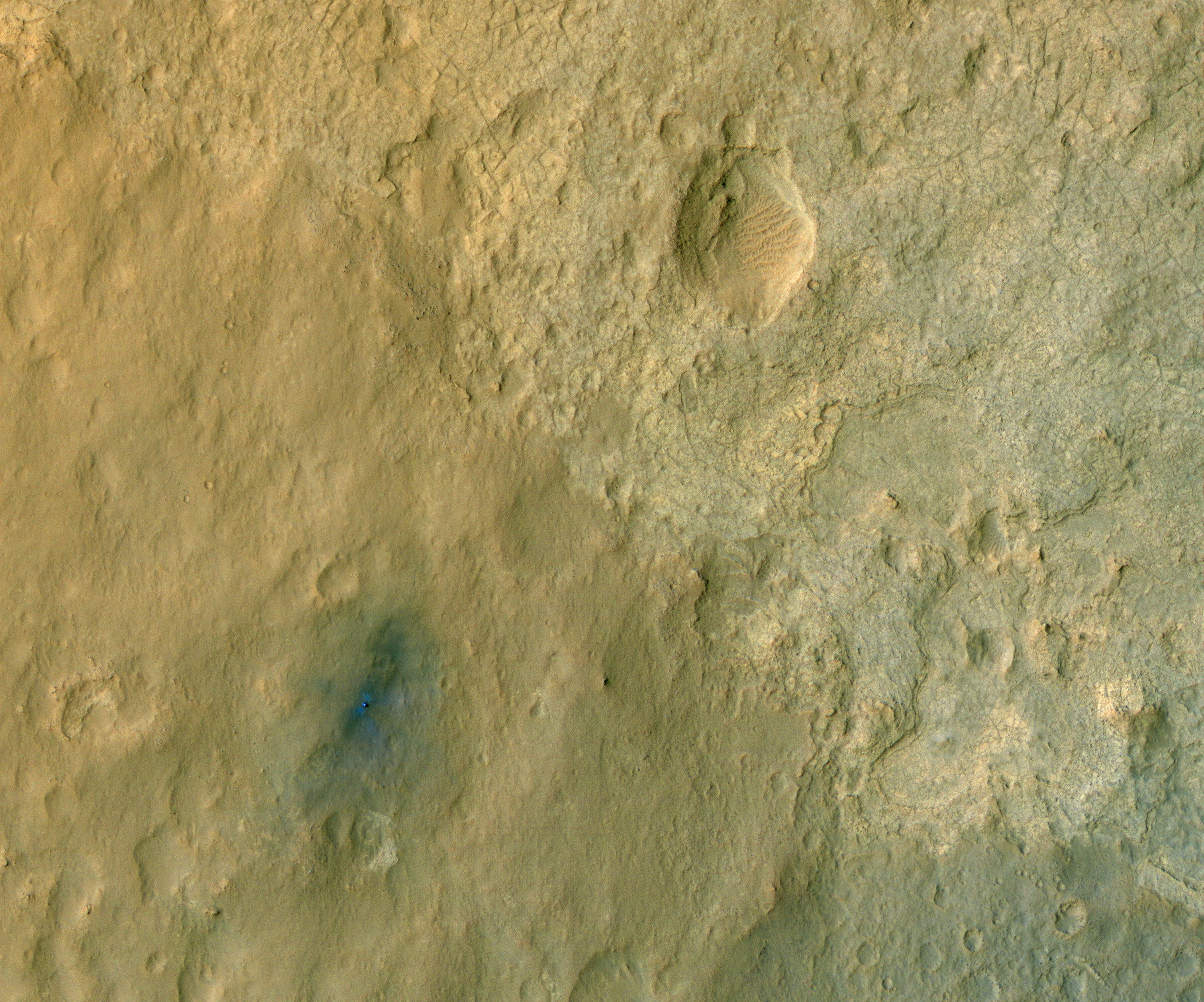
Nasa’s Curiosity Mars rover seen in new satellite image
By Jonathan Amos Science correspondent

The MRO image shows the terrain around the rover (double blue/white dot) at its landing site within Gale Crater on Mars. The blue fans either side are rocket blast marks in the ground
Nasa has used its high-resolution imaging satellite at the Red Planet to look down on the Curiosity rover and acquire a new picture of the recently landed six-wheeled robot.
The vehicle appears as a double dot.
The view from the Mars Reconnaissance Orbiter (MRO) has been colour enhanced to emphasise certain ground features.
These include the disturbance in the soil made either side of the vehicle by the rocket powered crane that lowered Curiosity into Gale Crater a week ago.
“We can clearly see Curiosity – it’s like two bright spots that we see, and their shadows. And then it’s surrounded by the blast pattern from the descent stage – those little blue fans right next to it (false colour blue),” explained Alfred McEwen, the principal investigator on MRO’s High Resolution Image Science Experiment (HiRise) camera.
Read more: http://www.bbc.co.uk/news/science-environment-19262486
Mars Rover Curiosity Sends First Full-Color Panorama of Its New Martian Home
360 degrees of lovely Gale Crater
By Rebecca Boyle Posted 08.09.2012

After a couple days of black-and-white imagery and blurry color thumbnails, the Mars rover Curiosity has downlinked its first full-color, 360-degree view of its new home in Gale Crater. Click past the jump to enlarge the whole thing–it’s incredible.
The image was brightened during its processing, because it’s not actually this sunny on Mars. The planet is another 50-ish million miles from the sun, and it only receives half the sunlight Earth does.
Scientist Discovers Plate Tectonics On Mars
ScienceDaily (Aug. 9, 2012) — For years, many scientists had thought that plate tectonics existed nowhere in our solar system but on Earth. Now, a UCLA scientist has discovered that the geological phenomenon, which involves the movement of huge crustal plates beneath a planet’s surface, also exists on Mars.

“Mars is at a primitive stage of plate tectonics. It gives us a glimpse of how the early Earth may have looked and may help us understand how plate tectonics began on Earth,” said An Yin, a UCLA professor of Earth and space sciences and the sole author of the new research.
Yin made the discovery during his analysis of satellite images from a NASA spacecraft known as THEMIS (Time History of Events and Macroscale Interactions during Substorms) and from the HIRISE (High Resolution Imaging Science Experiment) camera on NASA’s Mars Reconnaissance Orbiter. He analyzed about 100 satellite images — approximately a dozen were revealing of plate tectonics.
Read more: http://www.sciencedaily.com/releases/2012/08/120809155831.htm
Gliese 581g – The most habitable exoplanet
 |
This artist’s conception shows the inner four planets of the Gliese 581 system and their host star. The large planet in the foreground is Gliese 581g, which is in the middle of the star’s habitable zone and is only two to three times as massive as Earth. Some researchers aren’t convinced Gliese 581g exists, however.
CREDIT: Lynette Cook
The controversial exoplanet Gliese 581g is the best candidate to host life beyond our own solar system, according to a new ranking of potentially habitable alien worlds.
Gliese 581g shot to the top of the list — which was published Thursday (July 19) by researchers at the University of Puerto Rico at Arecibo’s Planetary Habitability Laboratory (PHL) — after a new study marshaled support for its long-debated existence.
The exoplanet was discovered in September 2010, but other astronomers began casting doubt on its existence just weeks later. Now Gliese 581g’s discoverers have rebutted their critics’ charges in a new paper, and have done so effectively enough to get the PHL onboard.
Read more: http://www.space.com/16722-top-5-habitable-alien-planets.html
Hubble sees the needle galaxy, edge-on and up close

Image credit: ESA/NASA
This image snapped by the NASA/ESA Hubble Space Telescope reveals an exquisitely detailed view of part of the disc of the spiral galaxy NGC 4565. This bright galaxy is one of the most famous examples of an edge-on spiral galaxy, oriented perpendicularly to our line of sight so that we see right into its luminous disc. NGC 4565 has been nicknamed the Needle Galaxy because, when seen in full, it appears as a very narrow streak of light on the sky.
The edgewise view into the Needle Galaxy shown here looks very similar to the view we have from our Solar System into the core of the Milky Way. In both cases ribbons of dust block some of the light coming from the galactic disc. To the lower right, the dust stands in even starker contrast against the copious yellow light from the star-filled central regions. NGC 4565’s core is off camera to the lower right.
Read more : http://phys.org/news/2012-07-hubble-needle-galaxy-edge-on.html
Hubble Discovers a Fifth Moon Orbiting Pluto
ScienceDaily (July 11, 2012) — A team of astronomers using NASA’s Hubble Space Telescope is reporting the discovery of another moon orbiting the icy dwarf planet Pluto.

The moon is estimated to be irregular in shape and 6 to 15 miles across. It is in a 58,000-mile-diameter circular orbit around Pluto that is assumed to be co-planar with the other satellites in the system.
“The moons form a series of neatly nested orbits, a bit like Russian dolls,” said team lead Mark Showalter of the SETI Institute in Mountain View, Calif.
The discovery increases the number of known moons orbiting Pluto to five.
The Pluto team is intrigued that such a small planet can have such a complex collection of satellites. The new discovery provides additional clues for unraveling how the Pluto system formed and evolved. The favored theory is that all the moons are relics of a collision between Pluto and another large Kuiper belt object billions of years ago.
Read more : http://www.sciencedaily.com/releases/2012/07/120711123038.htm
The real Mars
July 6, 2012
Written by : Joseph P. Skipper
http://www.marsanomalyresearch.com
 .
.
Verify M0902042 at MSSS and USGS.
.
Verify E0801033 at MSSS and USGS
(22 more images at http://www.marsanomalyresearch.com/evidence-reports/2012/221/real-mars.htm)
The visual evidence is presented here in two sampling blocks representing the better of the discoveries. In the first block you’ll see quite a few different bodies of water in a liquid state with some of these surrounded by the bonus of very conventional looking forests. The second block is all about samples of large form forest life Mars style none of which are by official consensus suppose to exist at all on this world.
Remember that the Mars surface is officially suppose to be completely dry and devoid of life. Further, the atmosphere is suppose to be 95.35% carbon dioxide (CO2) with only a very tiny .03% of water vapor and super hard frozen to the tune of as much as –220º Fahrenheit or –140º Celsius. In other words it would be a race as to whether an unprotected Earth human out in the open there would be speedily killed by too much poisonous CO2 gas by many times over or quickly frozen to death.
Note that, even though all of the following evidence is in the official science data and available there for verification, you have never heard a peep out of NASA or JPL as to its existence. So this amounts to the hidden Mars that it appears someone in control does not wish you and I to know about or at least also ignore. Also note that I have added a slight bit of false color to these online images to increase clarity and the viewing comfort level. In any case, the high drama visual evidence is as follows.
Read more : http://www.marsanomalyresearch.com/evidence-reports/2012/221/real-mars.htm
New Instrument Sifts Through Starlight to Reveal New Worlds
ScienceDaily (July 5, 2012) — An advanced telescope imaging system that started taking data last month is the first of its kind capable of spotting planets orbiting suns outside of our solar system. The collaborative set of high-tech instrumentation and software, called Project 1640, is now operating on the Hale telescope at the Palomar Observatory in California after more than six years of development by researchers and engineers at the American Museum of Natural History, the California Institute of Technology, and the Jet Propulsion Laboratory (JPL).

The project’s first images demonstrating a new technique that creates extremely precise “dark holes” around stars of interest were presented July 5 at the International Society for Optics and Photonics (SPIE) Astronomical Telescopes and Instrumentation meeting in Amsterdam by Ben R. Oppenheimer, a curator in the Museum’s Department of Astrophysics and principal investigator for Project 1640.
Although hundreds of planets are known from indirect detection methods to orbit other stars, it’s extremely difficult to see them directly in an image. This is largely because the light that stars emit is tens of millions to billions of times brighter than the light given off by planets.
Read more: http://www.sciencedaily.com/releases/2012/07/120705161252.htm
 Believe nothing