Archive
Stunning Mars Photo Shows Curiosity Rover’s Tracks from Space
 |
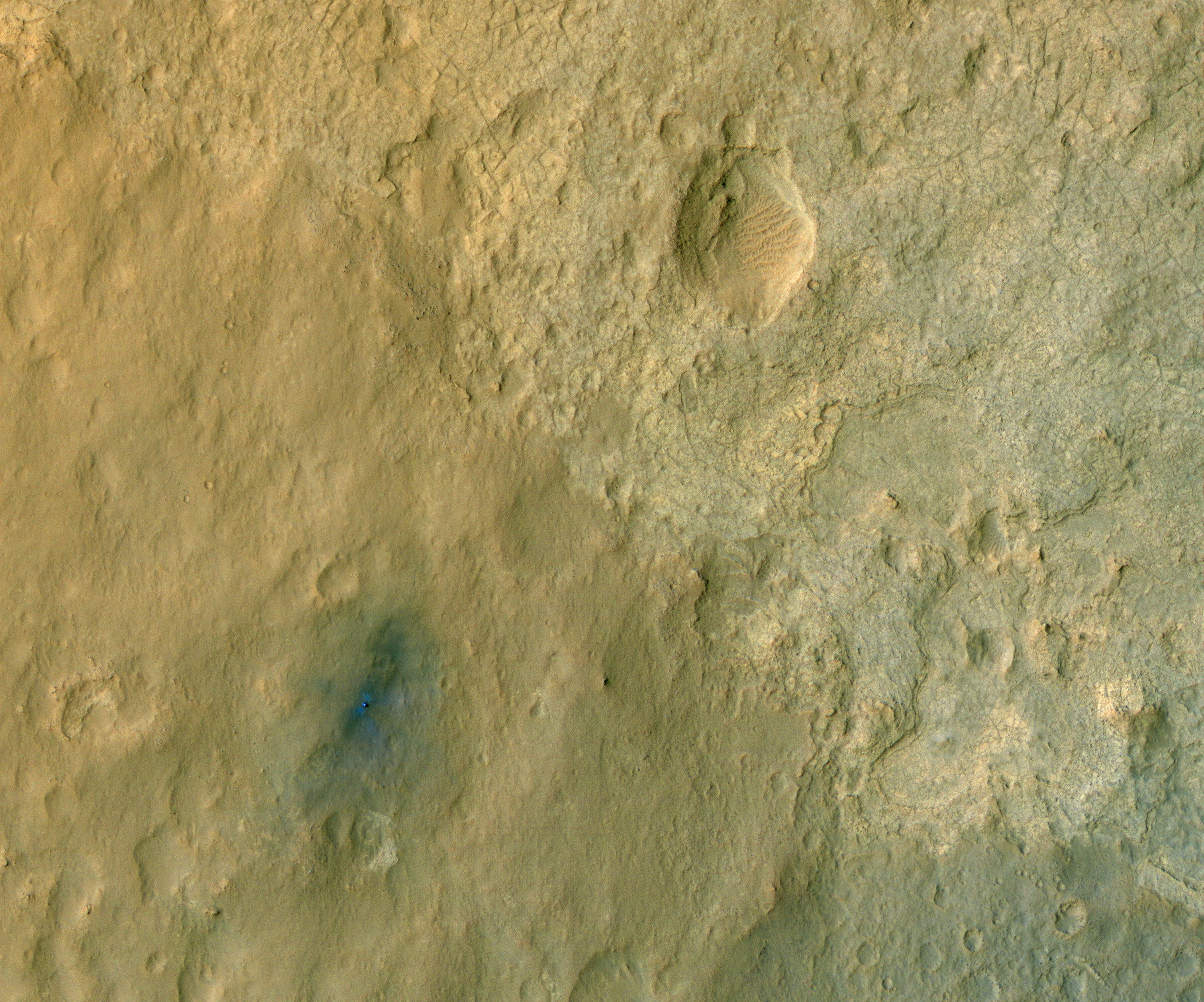
| Tracks from the first drives of NASA’s Mars rover Curiosity are visible in this image captured by the Mars Reconnaissance Orbiter. The rover is seen where the tracks end. The image’s color has been enhanced to show the surface details better. Image released Sept. 6, 2012. CREDIT: NASA/JPL-Caltech/Univ. of Arizona NASA’s newest Mars rover Curiosity is taking its first tentative drives across the Martian surface and leaving tracks that have been spotted all the way from space in a spectacular photo snapped by an orbiting spacecraft. The newview of Curiosity’s tracks from space was captured by NASA’s Mars Reconnaissance Orbiter and released today (Sept. 6). It shows the rover as a bright, boxy vehicle at the end of two tracks that create a single zig-zag pattern in the Martian surface. Read more: http://www.space.com/17485-amazing-mars-photos-curiosity-rover-space.html |
NASA Rover Returns Voice, Telephoto Views From Mars
August 28, 2012
 A chapter of the layered geological history of Mars is laid bare in this postcard from NASA’s Curiosity rover. The image shows the base of Mount Sharp, the rover’s eventual science destination. Image credit: NASA/JPL-Caltech/MSSS
PASADENA, Calif. — NASA’s Mars Curiosity has debuted the first recorded human voice that traveled from Earth to another planet and back.
In spoken words radioed to the rover on Mars and back to NASA’s Deep Space Network (DSN) on Earth, NASA Administrator Charles Bolden noted the difficulty of landing a rover on Mars, congratulated NASA employees and the agency’s commercial and government partners on the successful landing of Curiosity earlier this month, and said curiosity is what drives humans to explore.
“The knowledge we hope to gain from our observation and analysis of Gale Crater will tell us much about the possibility of life on Mars as well as the past and future possibilities for our own planet. Curiosity will bring benefits to Earth and inspire a new generation of scientists and explorers, as it prepares the way for a human mission in the not too distant future,” Bolden said in the recorded message.
The voice playback was released along with new telephoto camera views of the varied Martian landscape during a news conference today at NASA’s Jet Propulsion Laboratory, Pasadena, Calif.
Read more: http://www.nasa.gov/mission_pages/msl/news/msl20120827.html
› Full image and caption › Latest images › Curiosity gallery › Curiosity videos
Curiosity landing video assembled from high-res images (video)

Nasa’s Curiosity Mars rover seen in new satellite image
By Jonathan Amos Science correspondent

The MRO image shows the terrain around the rover (double blue/white dot) at its landing site within Gale Crater on Mars. The blue fans either side are rocket blast marks in the ground
Nasa has used its high-resolution imaging satellite at the Red Planet to look down on the Curiosity rover and acquire a new picture of the recently landed six-wheeled robot.
The vehicle appears as a double dot.
The view from the Mars Reconnaissance Orbiter (MRO) has been colour enhanced to emphasise certain ground features.
These include the disturbance in the soil made either side of the vehicle by the rocket powered crane that lowered Curiosity into Gale Crater a week ago.
“We can clearly see Curiosity – it’s like two bright spots that we see, and their shadows. And then it’s surrounded by the blast pattern from the descent stage – those little blue fans right next to it (false colour blue),” explained Alfred McEwen, the principal investigator on MRO’s High Resolution Image Science Experiment (HiRise) camera.
Read more: http://www.bbc.co.uk/news/science-environment-19262486
Mars Rover Curiosity Sends First Full-Color Panorama of Its New Martian Home
360 degrees of lovely Gale Crater
By Rebecca Boyle Posted 08.09.2012

After a couple days of black-and-white imagery and blurry color thumbnails, the Mars rover Curiosity has downlinked its first full-color, 360-degree view of its new home in Gale Crater. Click past the jump to enlarge the whole thing–it’s incredible.
The image was brightened during its processing, because it’s not actually this sunny on Mars. The planet is another 50-ish million miles from the sun, and it only receives half the sunlight Earth does.
Scientist Discovers Plate Tectonics On Mars
ScienceDaily (Aug. 9, 2012) — For years, many scientists had thought that plate tectonics existed nowhere in our solar system but on Earth. Now, a UCLA scientist has discovered that the geological phenomenon, which involves the movement of huge crustal plates beneath a planet’s surface, also exists on Mars.

“Mars is at a primitive stage of plate tectonics. It gives us a glimpse of how the early Earth may have looked and may help us understand how plate tectonics began on Earth,” said An Yin, a UCLA professor of Earth and space sciences and the sole author of the new research.
Yin made the discovery during his analysis of satellite images from a NASA spacecraft known as THEMIS (Time History of Events and Macroscale Interactions during Substorms) and from the HIRISE (High Resolution Imaging Science Experiment) camera on NASA’s Mars Reconnaissance Orbiter. He analyzed about 100 satellite images — approximately a dozen were revealing of plate tectonics.
Read more: http://www.sciencedaily.com/releases/2012/08/120809155831.htm
The real Mars
July 6, 2012
Written by : Joseph P. Skipper
http://www.marsanomalyresearch.com
 .
.
Verify M0902042 at MSSS and USGS.
.
Verify E0801033 at MSSS and USGS
(22 more images at http://www.marsanomalyresearch.com/evidence-reports/2012/221/real-mars.htm)
The visual evidence is presented here in two sampling blocks representing the better of the discoveries. In the first block you’ll see quite a few different bodies of water in a liquid state with some of these surrounded by the bonus of very conventional looking forests. The second block is all about samples of large form forest life Mars style none of which are by official consensus suppose to exist at all on this world.
Remember that the Mars surface is officially suppose to be completely dry and devoid of life. Further, the atmosphere is suppose to be 95.35% carbon dioxide (CO2) with only a very tiny .03% of water vapor and super hard frozen to the tune of as much as –220º Fahrenheit or –140º Celsius. In other words it would be a race as to whether an unprotected Earth human out in the open there would be speedily killed by too much poisonous CO2 gas by many times over or quickly frozen to death.
Note that, even though all of the following evidence is in the official science data and available there for verification, you have never heard a peep out of NASA or JPL as to its existence. So this amounts to the hidden Mars that it appears someone in control does not wish you and I to know about or at least also ignore. Also note that I have added a slight bit of false color to these online images to increase clarity and the viewing comfort level. In any case, the high drama visual evidence is as follows.
Read more : http://www.marsanomalyresearch.com/evidence-reports/2012/221/real-mars.htm
Evidence of Life On Mars Could Come from Martian Moon Phobos
ScienceDaily (June 29, 2012) — A mission to a Martian moon could return with alien life, according to experts at Purdue University, but don’t expect the invasion scenario presented by summer blockbusters like “Men in Black 3” or “Prometheus.”

“We are talking little green microbes, not little green men,” said Jay Melosh, a distinguished professor of earth, atmospheric and planetary sciences and physics and aerospace engineering at Purdue. “A sample from the moon Phobos, which is much easier to reach than the Red Planet itself, would almost surely contain Martian material blasted off from large asteroid impacts. If life on Mars exists or existed within the last 10 million years, a mission to Phobos could yield our first evidence of life beyond Earth.”
Read more : http://www.sciencedaily.com/releases/2012/06/120629015408.htm
ESPL: Dances of the Planets
June 19, 2012
The planets in the heavens move in exquisite orbital patterns, dancing to the Music of the Cosmos. There is more mathematical and geometric harmony than we realize. The idea for this article is from a book Larry Pesavento shared with me. The book, ‘A Little Book of Coincidence‘ by John Martineau, illustrates the orbital patterns and several of their geometrical relationships. .
Take the orbits of any two planets and draw a line between the two planet positions every few days. Because the inner planet orbits faster than the outer planet, interesting patterns evolve. Each planetary pairing has its own unique dance rhythm. For example, the Earth-Venus dance returns to the original starting position after eight Earth years. Eight Earth years equals thirteen Venus years. Note that 8 and 13 are members of the Fibonacci number series.
- Earth: 8 years * 365.256 days/year = 2,922.05 days
- Venus: 13 years * 224.701 days/year = 2,921.11 days (ie. 99.9%)
Watching the Earth-Venus dance for eight years creates this beautiful five-petal flower with the Sun at the center. (5 is another Fibonacci number.)

Another intriguing fact is the ratio between the Earth’s outer orbit and Venus’s inner orbit is given by a square.

In the following dance patterns, the planet pairing is given and the number of orbits of the outer planet. Enjoy these beautiful patterns.


Let me share with you other facts about cosmic harmony. The radius of the Moon compared to the Earth is three to eleven, ie. 3:11.
- Radius of Moon = 1,080 miles = 3 x 360
- Radius of Earth = 3,960 miles = 11 x 360 = 33 x 1 x 2 x 3 x 4 x 5
- Radius of Earth plus Radius of Moon = 5,040 miles = 1 x 2 x 3 x 4 x 5 x 6 x 7 = 7 x 8 x 9 x 10
The ratio 3:11 is 27.3 percent, and the orbit of the Moon takes 27.3 days. 27.3 days is also the average rotation period of a sunspot. The closest : farthest distance ratio that Venus and Mars each experiences in the Mars-Venus dance is incredibly 3:11. The Earth orbits between them.
The sizes of the Moon and the Earth ‘Square the Circle’ as shown in this illustration, which is drawn to scale. The perimeters of the dotted square and the dotted circle are the same length.

The perimeter of the dotted red square is 4 x Earth’s diameter = 4 x 7,920 miles = 31,680 miles.
The circumference of the dotted blue circle is 2 pi x radius = 2 x 3.142 x 5040 miles = 31,667 miles. (ie. 99.9%)
Article by Howard Arrington
Engineer Details Plans to Build a Real, Burj-Dubai-Sized Starship Enterprise in 20 Years
By Rebecca Boyle Posted 05.14.2012

The year 2245 is just too distant — we should build and commission a real USS Enterprise right now, cracking the champagne across her hull within 20 years, according to an enterprising engineer. The gigantic ship would use ion propulsion, powered by a 1.5-GW nuclear reactor, and could reach Mars in three months and the moon in three days. Its 0.3-mile-diameter, magnetically suspended gravity wheel spinning at 2 RPM would provide 1G of gravity, and the thing looks just like the “Star Trek” ship of lore.
This project is the brainchild of an engineer who calls himself BTE Dan. As in “Build The Enterprise,” which is also the name of his brand-new website.
“We have the technological reach to build the first generation of the spaceship known as the USS Enterprise – so let’s do it,” BTE Dan writes. He even sifts through the federal budget and proposes tax hikes and spend ing cuts to cover the $1 trillion cost.
Though the “Star Trek” connection lends the project an air of sci-fi fun, BTE Dan is hardly the only engineer dreaming up a next-generation spaceship to the stars. DARPA’s 100-Year Starship project is designed partly to foster ideas just like this one, from a project planning roadmap to a real ship.
 Believe nothing