Archive
CERN’s Large Hadron Collider Experiments Bring New Insight Into Matter of the Primordial Universe
ScienceDaily (Aug. 13, 2012) — Experiments using heavy ions at CERN’s Large Hadron Collider (LHC) are advancing understanding of the primordial Universe. The ALICE, ATLAS and CMS collaborations have made new measurements of the kind of matter that probably existed in the first instants of the Universe. They will present their latest results at the 2012 Quark Matter conference, which starts August 13 in Washington DC. The new findings are based mainly on the four-week LHC run with lead ions in 2011, during which the experiments collected 20 times more data than in 2010.

Just after the Big Bang, quarks and gluons — basic building blocks of matter — were not confined inside composite particles such as protons and neutrons, as they are today. Instead, they moved freely in a state of matter known as ‘quark-gluon plasma’. Collisions of lead ions in the LHC, the world’s most powerful particle accelerator, recreate for a fleeting moment conditions similar to those of the early Universe. By examining a billion or so of these collisions, the experiments have been able to make more precise measurements of the properties of matter under these extreme conditions.
“The field of heavy-ion physics is crucial for probing the properties of matter in the primordial Universe, one of the key questions of fundamental physics that the LHC and its experiments are designed to address. It illustrates how in addition to the investigation of the recently discovered Higgs-like boson, physicists at the LHC are studying many other important phenomena in both proton-proton and lead-lead collisions,” said CERN Director General Rolf Heuer.
Read more: http://www.sciencedaily.com/releases/2012/08/120813115445.htm
Mars Rover Curiosity Sends First Full-Color Panorama of Its New Martian Home
360 degrees of lovely Gale Crater
By Rebecca Boyle Posted 08.09.2012

After a couple days of black-and-white imagery and blurry color thumbnails, the Mars rover Curiosity has downlinked its first full-color, 360-degree view of its new home in Gale Crater. Click past the jump to enlarge the whole thing–it’s incredible.
The image was brightened during its processing, because it’s not actually this sunny on Mars. The planet is another 50-ish million miles from the sun, and it only receives half the sunlight Earth does.
Scientist Discovers Plate Tectonics On Mars
ScienceDaily (Aug. 9, 2012) — For years, many scientists had thought that plate tectonics existed nowhere in our solar system but on Earth. Now, a UCLA scientist has discovered that the geological phenomenon, which involves the movement of huge crustal plates beneath a planet’s surface, also exists on Mars.

“Mars is at a primitive stage of plate tectonics. It gives us a glimpse of how the early Earth may have looked and may help us understand how plate tectonics began on Earth,” said An Yin, a UCLA professor of Earth and space sciences and the sole author of the new research.
Yin made the discovery during his analysis of satellite images from a NASA spacecraft known as THEMIS (Time History of Events and Macroscale Interactions during Substorms) and from the HIRISE (High Resolution Imaging Science Experiment) camera on NASA’s Mars Reconnaissance Orbiter. He analyzed about 100 satellite images — approximately a dozen were revealing of plate tectonics.
Read more: http://www.sciencedaily.com/releases/2012/08/120809155831.htm
Higgs boson results from LHC ‘get even stronger’
August 3, 2012
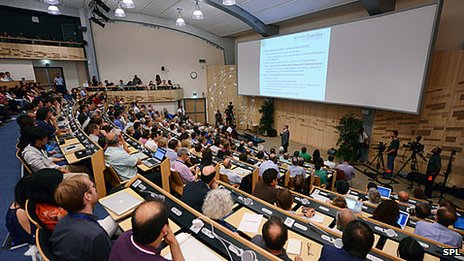
The particle has been the subject of a decades-long hunt as the last missing piece of physics’ Standard Model, explaining why matter has mass.
Now one Higgs-hunting team at the Large Hadron Collider report a “5.9 sigma” levels of certainty it exists.
That equates to a one-in-550 million chance if the Higgs did not exist, the team would see these same results.
The formal threshold for claiming the discovery of a particle is a 5-sigma level – equivalent to a one-in-3.5 million chance.
That is the level that was claimed by the team behind Atlas, one of the LHC’s Higgs-hunting experiments, during the 4 July announcement. The other, known as CMS, claimed results between 4.9 and 5 sigma.
Read more: http://www.bbc.co.uk/news/science-environment-19076355
You Think GMO Is Scary? Nano Tech is Here, In Your Store
Tuesday, 31 July 2012

‘Nanotechnology is measured in billionths of a meter, encompassing all aspects of life from food to medicine, clothing, to space. Imagine hundreds of microcomputers on the width of a strand of hair programmed for specific tasks….in your body. Sound good?
Engineering at a molecular level may be a future corporations’ dream come true, however, nano-particles inside your body have few long-term studies especially when linked to health issues. Despite this new huge income-generating field there is a growing body of toxicological information suggesting that nanotechnology when consumed can cause brain damage (as shown in largemouth bass), and therefore should undergo a full safety assessment.’
Read more: You Think GMO Is Scary? Nano Tech is Here, In Your Store
1st Photos from New Discovery Channel Telescope Unveiled
 |
One of the first images captured by the Discovery Channel Telescope in Arizona shows the barred spiral galaxy M109. The privately funded observatory took its first photos in May 2012.
CREDIT: Lowell Observatory
The Discovery Channel Telescope is an observatory with a 14-foot (4.3-meter) mirror built near Happy Jack, Ariz., by the Lowell Observatory and Discovery Communications, the parent company of television’s Discovery Channel. The telescope’s opening was marked with a gala on Saturday (July 21) at Lowell Observatory in Flagstaff and featured a keynote speech from Neil Armstrong, the first person ever on the moon.
“The First Light Gala is a historic event in the annals of Lowell Observatory,” Jeffrey Hall, director of Lowell Observatory, said in a statement. “It marks completion of our spectacular new research facility, initiation of superb projects that will bring our research to millions through our partnership with Discovery Communications. We are honored to be part of it and grateful to all who have helped make it a reality.”
Read more: http://www.space.com/16706-discovery-channel-telescope-first-photos.html
Gliese 581g – The most habitable exoplanet
 |
This artist’s conception shows the inner four planets of the Gliese 581 system and their host star. The large planet in the foreground is Gliese 581g, which is in the middle of the star’s habitable zone and is only two to three times as massive as Earth. Some researchers aren’t convinced Gliese 581g exists, however.
CREDIT: Lynette Cook
The controversial exoplanet Gliese 581g is the best candidate to host life beyond our own solar system, according to a new ranking of potentially habitable alien worlds.
Gliese 581g shot to the top of the list — which was published Thursday (July 19) by researchers at the University of Puerto Rico at Arecibo’s Planetary Habitability Laboratory (PHL) — after a new study marshaled support for its long-debated existence.
The exoplanet was discovered in September 2010, but other astronomers began casting doubt on its existence just weeks later. Now Gliese 581g’s discoverers have rebutted their critics’ charges in a new paper, and have done so effectively enough to get the PHL onboard.
Read more: http://www.space.com/16722-top-5-habitable-alien-planets.html
Debt
Tuesday, 24 July 2012 
Solar Corona Revealed in Super-High-Definition
ScienceDaily (July 20, 2012) — Astronomers have just released the highest-resolution images ever taken of the Sun’s corona, or million-degree outer atmosphere, in an extreme-ultraviolet wavelength of light. The 16-megapixel images were captured by NASA’s High Resolution Coronal Imager, or Hi-C, which was launched on a sounding rocket on July 11th. The Hi-C telescope provides five times more detail than the next-best observations by NASA’s Solar Dynamics Observatory.

These photos of the solar corona, or million-degree outer atmosphere, show the improvement in resolution offered by NASA’s High Resolution Coronal Imager, or Hi-C (bottom), versus the Atmospheric Imaging Assembly on NASA’s Solar Dynamics Observatory (top). Both images show a portion of the sun’s surface roughly 85,000 by 50,000 miles in size. Hi-C launched on a sounding rocket on July 11, 2012 in a flight that lasted about 10 minutes. The representative-color images were made from observations of ultraviolet light at a wavelength of 19.3 nanometers (25 times shorter than the wavelength of visible light). (Credit: NASA)
“Even though this mission was only a few minutes long, it marks a big breakthrough in coronal studies,” said Smithsonian astronomer Leon Golub (Harvard-Smithsonian Center for Astrophysics), one of the lead investigators on the mission.
Understanding the Sun’s activity and its effects on Earth’s environment was the critical scientific objective of Hi-C, which provided unprecedented views of the dynamic activity and structure in the solar atmosphere.
Read more: http://www.sciencedaily.com/releases/2012/07/120720195519.htm
Geoengineers Will Release Tons of Sun-Reflecting Chemicals Into the Air Above New Mexico
By Colin Lecher Posted 07.18.2012

Even if they can be a major disaster for people nearby them, volcanoes do one good thing: helping to cool the planet by sending sun-reflecting chemicals into the stratosphere. Now two Harvard engineers are trying to replicate the better part of the volcanic process on a small scale by spraying thousands of tons of sulfate aerosols into the atmosphere above New Mexico.
 Believe nothing
