Archive
Chile Volcano Erupts, Forces Evacuation
Sunday, 05 June 2011 06:32

‘Thousands of people in Chile have received evacuation orders after the southern Puyehue volcano erupted for the first time in half a century. Some 3,500 people were ordered to evacuate their homes as the Puyehue-Cordon Caulle volcanic chain produced a 10-kilometer high column of smoke, AFP reported.’
From Their Own Mouths: Global Warming is a Fraud
Thursday, 02 June 2011 08:58
http://www.youtube.com/watch?v=q20cnn8vOfg&feature=player_embedded
‘”We need to get some broad based support, to capture the public’s imagination… So we have to offer up scary scenarios, make simplified, dramatic statements and make little mention of any doubts… Each of us has to decide what the right balance is between being effective and being honest.” – Stephen Schneider, Stanford Professor of Climatology, lead author of many IPCC reports
“No matter if the science of global warming is all phony… climate change provides the greatest opportunity to bring about justice and equality in the world.” – Christine Stewart, fmr Canadian Minister of the Environment.’
Tornado kills at least 4 in Springfield, MA
UPDATE [9:22 p.m. ET]:
CBS Boston reports that today’s tornadoes have caused 4 deaths.
ORIGINAL STORY:
A tornado touched down in Springfield, Massachusetts late this afternoon, CNN reports.
22 News WWLP says the tornado formed at about 4:20 this afternoon. At least one person was killed, many injured and Massachusetts Gov. Deval Patrick said he has declared a state of emergency for Massachusetts, per CNN.
A second tornado touched down in nearby Westfield, Massachusetts just a few hours later.
Patrick said as many as 26,000 people were without electrical service, and that at least 19 communities were affected by the storms.
WTNH News has posted pictures to its Twitter feed and has a live report.
Click here for another picture from WTNH.
Global Earthquake and Volcano Overview — Worldwide Increase in Activity
Land around Fukushima Now Radioactive Dead Zone; Resembles Target Struck by Atomic Bomb
Wednesday, 01 June 2011 07:55

‘It is nothing short of astonishing that the nuclear catastrophe we’ve all been told was “no big deal” has now escalated into the worst nuclear disaster in the history of human civilization. It’s so bad now that soil samples taken from outside the 12-mile exclusion zone (the zone considered safe enough by the Japanese government for schoolchildren to attend school there) are higher than the 1.48 million becquerels a square meter limit that triggered evacuations outside Chernobyl in 1986.
In other words, the radiation level of the soil 12 miles from Fukushima is now higher than the levels considered too dangerous to live in near Chernobyl. This is all coming out in a new research report authored by Tomio Kawata, a fellow at the Nuclear Waste Management Organization of Japan. That same report also reveals that radiation from Fukushima has spread over 230 square miles.’
Read more: Land around Fukushima Now Radioactive Dead Zone; Resembles Target Struck by Atomic Bomb
Mobile phones may cause cancer

Mobile phone owners were urged to limit their use last night after the World Health Organisation admitted they may cause cancer.
The UN’s health agency advised ‘pragmatic’ measures to reduce exposure, such as using hands-free kits and texting instead of calling.
The disturbing report marks the first time the WHO has linked mobiles with cancer, and follows earlier research linking just half an hour’s use a day with up to 40 per cent higher odds of brain cancer.
However the mobile phone industry was quick to point out that the devices had not been directly shown to cause cancer.
More than 70million mobile phones are now in use in Britain – more than one for every man, woman and child. Worldwide, the total tops five billion.
Dr Christopher Wild, director of the WHO’s International Agency for Research on Cancer, said: ‘Given the potential consequences for public health, it is important that additional research be conducted into the long-term, heavy use of mobile phones.
‘Pending the availability of such information, it is important to take pragmatic measures to reduce exposure, such as hands-free devices and texting.’
IARC’s conclusion follows a week-long review of all available scientific evidence by 21 scientists from 14 countries, including fresh research that has yet to be published.
The working group concluded that mobile phone use is ‘possibly carcinogenic’, a term which places the phones in the middle of five tiers of possible carcinogens.
Our ocean’s turning into plastic

Last month researchers from the 5 Gyres Institute in Santa Monica, California, and the Algalita Marine Research Foundation in Long Beach, California, sailed into Piriápolis, Uruguay. They had just completed the third leg of the first expedition ever to study plastic pollution in the South Atlantic subtropical gyre. In every single trawl, the team discovered plastic.
“This issue has only recently come to the public’s attention,” says Anna Cummins, co-founder of 5 Gyres. “We’re trying to document the issue and get baseline information because there is such a scarcity of data.”
There are still significant gaps in the data the crew can collect, however. The nets that they use cannot capture plastic particles that are smaller than one-third of a millimetre across. After a certain size these particles just disappear. Trawling gathers only plastic particles from surface waters. Different kinds of plastic may be suspended at different depths – a dreadful rainbow of rubbish spanning the ocean from top to bottom – but no one has done the research to find out.
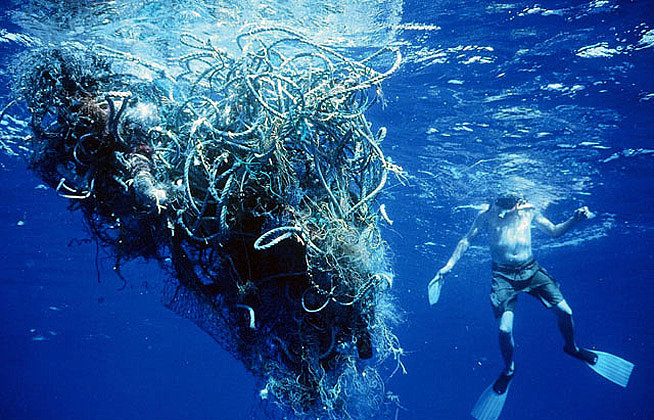
 Every flake of plastic cup or shard of toothbrush handle is a sponge for persistent organic pollutants(POPs) – potentially hazardous compounds that do not degrade easily and cling to any hard surface they find. The fate of all this plastic determines not only the health of marine life, but also our own – if fish are feasting on these toxic morsels, then we probably are too.
5 Gyres researchers are currently investigating whether surface-feeding fish are ingesting plastic – and if so, what that does to them. By sampling the water and plastic, researchers used a special net to collect around 660 lanternfish – a ubiquitous family of small bioluminescent fish that make up around 65 per cent of all deep sea fish biomass. Lanternfish inhabit the dim depths during the day, but swim to the surface at night to feed so it would probably had some plastic in the guts. Water and plastic samples for the presence of POPs.
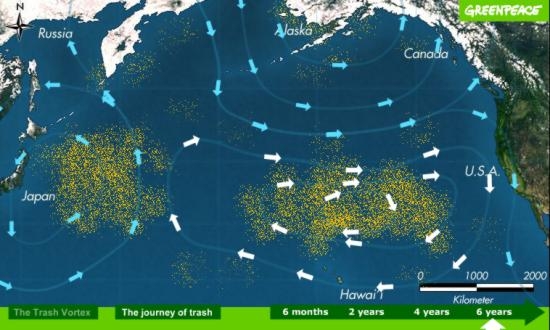
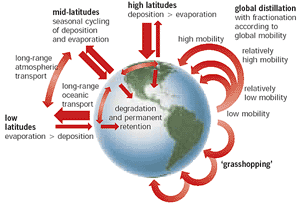
Plastic in the ocean would not be so worrisome if only certain areas were polluted, but it appears to travel everywhere. It’s hard to pin down exactly where the remains of a candy wrapper blown out to sea in China will eventually drift. For at least two decades oceanographers have deployed thousands of Lagrangian drifting buoys, which are designed to map surface ocean currents rather than wind patterns or waves. Wherever the buoys gather most densely is also where plastic particles should cluster. And that is what the researchers have found so far – all our plastic waste meets and circulates in the gyrating wastes of the ocean.
More surprising is that despite the lure of the gyres, the buoys – and, therefore, probably plastic in general – really get around. What researchers have established so far is that the plastic in the oceans is persistent and pervasive. Investigations into what all this pollution means for wildlife and people are just getting started, but the early signs are not reassuring. (NewScientist)
“The ocean is not infinite. It doesn’t have room for our waste!”http://thewatchers.adorraeli.com/2011/03/28/ocean-polluted-with-pops/
Worst ever carbon emissions leave climate on the brink

Greenhouse gas emissions increased by a record amount last year, to the highest carbon output in history, putting hopes of holding global warming to safe levels all but out of reach, according to unpublished estimates from the International Energy Agency.
The shock rise means the goal of preventing a temperature rise of more than 2 degrees Celsius – which scientists say is the threshold for potentially “dangerous climate change” – is likely to be just “a nice Utopia”, according to Fatih Birol, chief economist of the IEA. It also shows the most serious global recession for 80 years has had only a minimal effect on emissions, contrary to some predictions.
Last year, a record 30.6 gigatonnes of carbon dioxide poured into the atmosphere, mainly from burning fossil fuel – a rise of 1.6Gt on 2009, according to estimates from the IEA regarded as the gold standard for emissions data.
“I am very worried. This is the worst news on emissions,” Birol told the Guardian. “It is becoming extremely challenging to remain below 2 degrees. The prospect is getting bleaker. That is what the numbers say.”
Professor Lord Stern of the London School of Economics, the author of the influential Stern Report into the economics of climate change for the Treasury in 2006, warned that if the pattern continued, the results would be dire. “These figures indicate that [emissions] are now close to being back on a ‘business as usual’ path. According to the [Intergovernmental Panel on Climate Change’s] projections, such a path … would mean around a 50% chance of a rise in global average temperature of more than 4C by 2100,” he said.
“Such warming would disrupt the lives and livelihoods of hundreds of millions of people across the planet, leading to widespread mass migration and conflict. That is a risk any sane person would seek to drastically reduce.”
Birol said disaster could yet be averted, if governments heed the warning. “If we have bold, decisive and urgent action, very soon, we still have a chance of succeeding,” he said.
The IEA has calculated that if the world is to escape the most damaging effects of global warming, annual energy-related emissions should be no more than 32Gt by 2020. If this year’s emissions rise by as much as they did in 2010, that limit will be exceeded nine years ahead of schedule, making it all but impossible to hold warming to a manageable degree.
Emissions from energy fell slightly between 2008 and 2009, from 29.3Gt to 29Gt, due to the financial crisis. A small rise was predicted for 2010 as economies recovered, but the scale of the increase has shocked the IEA. “I was expecting a rebound, but not such a strong one,” said Birol, who is widely regarded as one of the world’s foremost experts on energy.
John Sauven, the executive director of Greenpeace UK, said time was running out. “This news should shock the world. Yet even now politicians in each of the great powers are eyeing up extraordinary and risky ways to extract the world’s last remaining reserves of fossil fuels – even from under the melting ice of the Arctic. You don’t put out a fire with gasoline. It will now be up to us to stop them.”
Most of the rise – about three-quarters – has come from developing countries, as rapidly emerging economies have weathered the financial crisis and the recession that has gripped most of the developed world.
But he added that, while the emissions data was bad enough news, there were other factors that made it even less likely that the world would meet its greenhouse gas targets.
• About 80% of the power stations likely to be in use in 2020 are either already built or under construction, the IEA found. Most of these are fossil fuel power stations unlikely to be taken out of service early, so they will continue to pour out carbon – possibly into the mid-century. The emissions from these stations amount to about 11.2Gt, out of a total of 13.7Gt from the electricity sector. These “locked-in” emissions mean savings must be found elsewhere.
“It means the room for manoeuvre is shrinking,” warned Birol.
• Another factor that suggests emissions will continue their climb is the crisis in the nuclear power industry. Following the tsunami damage at Fukushima, Japan and Germany have called a halt to their reactor programmes, and other countries are reconsidering nuclear power.
“People may not like nuclear, but it is one of the major technologies for generating electricity without carbon dioxide,” said Birol. The gap left by scaling back the world’s nuclear ambitions is unlikely to be filled entirely by renewable energy, meaning an increased reliance on fossil fuels.
• Added to that, the United Nations-led negotiations on a new global treaty on climate change have stalled. “The significance of climate change in international policy debates is much less pronounced than it was a few years ago,” said Birol.
He urged governments to take action urgently. “This should be a wake-up call. A chance [of staying below 2 degrees] would be if we had a legally binding international agreement or major moves on clean energy technologies, energy efficiency and other technologies.”
Governments are to meet next week in Bonn for the next round of the UN talks, but little progress is expected.
Sir David King, former chief scientific adviser to the UK government, said the global emissions figures showed that the link between rising GDP and rising emissions had not been broken. “The only people who will be surprised by this are people who have not been reading the situation properly,” he said.
Forthcoming research led by Sir David will show the west has only managed to reduce emissions by relying on imports from countries such as China.
Another telling message from the IEA’s estimates is the relatively small effect that the recession – the worst since the 1930s – had on emissions. Initially, the agency had hoped the resulting reduction in emissions could be maintained, helping to give the world a “breathing space” and set countries on a low-carbon path. The new estimates suggest that
http://www.guardian.co.uk/environment/2011/may/29/carbon-emissions-nuclearpower
 Believe nothing