Archive
Our ocean’s turning into plastic

Last month researchers from the 5 Gyres Institute in Santa Monica, California, and the Algalita Marine Research Foundation in Long Beach, California, sailed into Piriápolis, Uruguay. They had just completed the third leg of the first expedition ever to study plastic pollution in the South Atlantic subtropical gyre. In every single trawl, the team discovered plastic.
“This issue has only recently come to the public’s attention,” says Anna Cummins, co-founder of 5 Gyres. “We’re trying to document the issue and get baseline information because there is such a scarcity of data.”
There are still significant gaps in the data the crew can collect, however. The nets that they use cannot capture plastic particles that are smaller than one-third of a millimetre across. After a certain size these particles just disappear. Trawling gathers only plastic particles from surface waters. Different kinds of plastic may be suspended at different depths – a dreadful rainbow of rubbish spanning the ocean from top to bottom – but no one has done the research to find out.
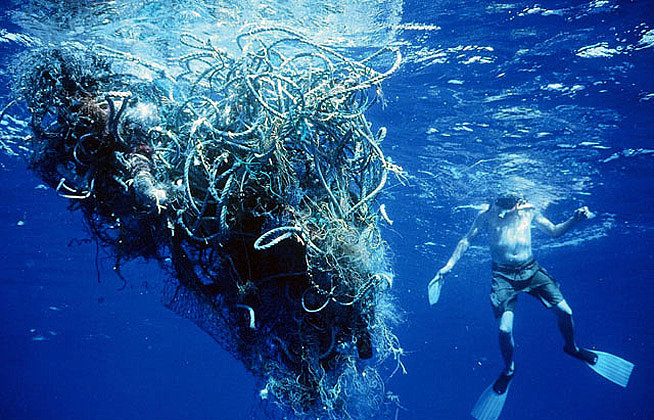
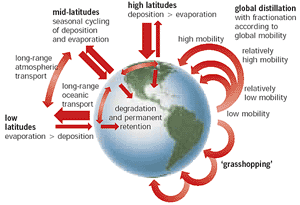 Every flake of plastic cup or shard of toothbrush handle is a sponge for persistent organic pollutants(POPs) – potentially hazardous compounds that do not degrade easily and cling to any hard surface they find. The fate of all this plastic determines not only the health of marine life, but also our own – if fish are feasting on these toxic morsels, then we probably are too.
5 Gyres researchers are currently investigating whether surface-feeding fish are ingesting plastic – and if so, what that does to them. By sampling the water and plastic, researchers used a special net to collect around 660 lanternfish – a ubiquitous family of small bioluminescent fish that make up around 65 per cent of all deep sea fish biomass. Lanternfish inhabit the dim depths during the day, but swim to the surface at night to feed so it would probably had some plastic in the guts. Water and plastic samples for the presence of POPs.
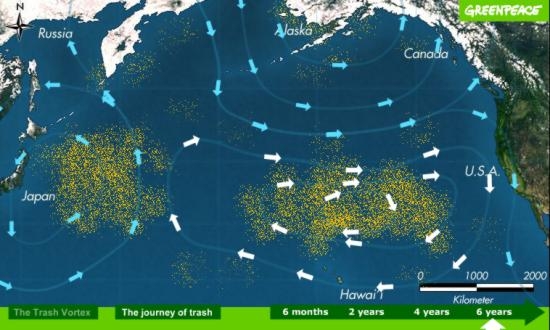
Plastic in the ocean would not be so worrisome if only certain areas were polluted, but it appears to travel everywhere. It’s hard to pin down exactly where the remains of a candy wrapper blown out to sea in China will eventually drift. For at least two decades oceanographers have deployed thousands of Lagrangian drifting buoys, which are designed to map surface ocean currents rather than wind patterns or waves. Wherever the buoys gather most densely is also where plastic particles should cluster. And that is what the researchers have found so far – all our plastic waste meets and circulates in the gyrating wastes of the ocean.
More surprising is that despite the lure of the gyres, the buoys – and, therefore, probably plastic in general – really get around. What researchers have established so far is that the plastic in the oceans is persistent and pervasive. Investigations into what all this pollution means for wildlife and people are just getting started, but the early signs are not reassuring. (NewScientist)
“The ocean is not infinite. It doesn’t have room for our waste!”http://thewatchers.adorraeli.com/2011/03/28/ocean-polluted-with-pops/
Worst ever carbon emissions leave climate on the brink

Greenhouse gas emissions increased by a record amount last year, to the highest carbon output in history, putting hopes of holding global warming to safe levels all but out of reach, according to unpublished estimates from the International Energy Agency.
The shock rise means the goal of preventing a temperature rise of more than 2 degrees Celsius – which scientists say is the threshold for potentially “dangerous climate change” – is likely to be just “a nice Utopia”, according to Fatih Birol, chief economist of the IEA. It also shows the most serious global recession for 80 years has had only a minimal effect on emissions, contrary to some predictions.
Last year, a record 30.6 gigatonnes of carbon dioxide poured into the atmosphere, mainly from burning fossil fuel – a rise of 1.6Gt on 2009, according to estimates from the IEA regarded as the gold standard for emissions data.
“I am very worried. This is the worst news on emissions,” Birol told the Guardian. “It is becoming extremely challenging to remain below 2 degrees. The prospect is getting bleaker. That is what the numbers say.”
Professor Lord Stern of the London School of Economics, the author of the influential Stern Report into the economics of climate change for the Treasury in 2006, warned that if the pattern continued, the results would be dire. “These figures indicate that [emissions] are now close to being back on a ‘business as usual’ path. According to the [Intergovernmental Panel on Climate Change’s] projections, such a path … would mean around a 50% chance of a rise in global average temperature of more than 4C by 2100,” he said.
“Such warming would disrupt the lives and livelihoods of hundreds of millions of people across the planet, leading to widespread mass migration and conflict. That is a risk any sane person would seek to drastically reduce.”
Birol said disaster could yet be averted, if governments heed the warning. “If we have bold, decisive and urgent action, very soon, we still have a chance of succeeding,” he said.
The IEA has calculated that if the world is to escape the most damaging effects of global warming, annual energy-related emissions should be no more than 32Gt by 2020. If this year’s emissions rise by as much as they did in 2010, that limit will be exceeded nine years ahead of schedule, making it all but impossible to hold warming to a manageable degree.
Emissions from energy fell slightly between 2008 and 2009, from 29.3Gt to 29Gt, due to the financial crisis. A small rise was predicted for 2010 as economies recovered, but the scale of the increase has shocked the IEA. “I was expecting a rebound, but not such a strong one,” said Birol, who is widely regarded as one of the world’s foremost experts on energy.
John Sauven, the executive director of Greenpeace UK, said time was running out. “This news should shock the world. Yet even now politicians in each of the great powers are eyeing up extraordinary and risky ways to extract the world’s last remaining reserves of fossil fuels – even from under the melting ice of the Arctic. You don’t put out a fire with gasoline. It will now be up to us to stop them.”
Most of the rise – about three-quarters – has come from developing countries, as rapidly emerging economies have weathered the financial crisis and the recession that has gripped most of the developed world.
But he added that, while the emissions data was bad enough news, there were other factors that made it even less likely that the world would meet its greenhouse gas targets.
• About 80% of the power stations likely to be in use in 2020 are either already built or under construction, the IEA found. Most of these are fossil fuel power stations unlikely to be taken out of service early, so they will continue to pour out carbon – possibly into the mid-century. The emissions from these stations amount to about 11.2Gt, out of a total of 13.7Gt from the electricity sector. These “locked-in” emissions mean savings must be found elsewhere.
“It means the room for manoeuvre is shrinking,” warned Birol.
• Another factor that suggests emissions will continue their climb is the crisis in the nuclear power industry. Following the tsunami damage at Fukushima, Japan and Germany have called a halt to their reactor programmes, and other countries are reconsidering nuclear power.
“People may not like nuclear, but it is one of the major technologies for generating electricity without carbon dioxide,” said Birol. The gap left by scaling back the world’s nuclear ambitions is unlikely to be filled entirely by renewable energy, meaning an increased reliance on fossil fuels.
• Added to that, the United Nations-led negotiations on a new global treaty on climate change have stalled. “The significance of climate change in international policy debates is much less pronounced than it was a few years ago,” said Birol.
He urged governments to take action urgently. “This should be a wake-up call. A chance [of staying below 2 degrees] would be if we had a legally binding international agreement or major moves on clean energy technologies, energy efficiency and other technologies.”
Governments are to meet next week in Bonn for the next round of the UN talks, but little progress is expected.
Sir David King, former chief scientific adviser to the UK government, said the global emissions figures showed that the link between rising GDP and rising emissions had not been broken. “The only people who will be surprised by this are people who have not been reading the situation properly,” he said.
Forthcoming research led by Sir David will show the west has only managed to reduce emissions by relying on imports from countries such as China.
Another telling message from the IEA’s estimates is the relatively small effect that the recession – the worst since the 1930s – had on emissions. Initially, the agency had hoped the resulting reduction in emissions could be maintained, helping to give the world a “breathing space” and set countries on a low-carbon path. The new estimates suggest that
http://www.guardian.co.uk/environment/2011/may/29/carbon-emissions-nuclearpower
Global food prices ‘to double’ by 2030

OXFAM has called for the global food system to be overhauled in response to fears staple food prices could more than double over the next 20 years.
In a report, the charity predicts that prices of staple crops like wheat and maize will rise by 120 to 180 per cent by 2030.
It says the biggest driver will be climate change, which could account for as much as half the increase, the report says.
Other factors include the rising global population, changing diets, shortages of land and water and the use of crops for biofuels, it says.
Despite projections that demand for food will increase by 70 per cent by 2050, the growth rate in agriculture yields is set to decline to less than 1 per cent in the next decade.
“We are sleepwalking towards an avoidable age of crisis. One in seven people on the planet go hungry every day despite the fact that the world is capable of feeding everyone,” Barbara Stocking, Oxfam’s chief executive said.
“The food system must be overhauled if we are to overcome the increasingly pressing challenges of climate change, spiralling food prices and the scarcity of land, water and energy.”
Oxfam is calling on governments across the globe to take actions to avert a potential food crisis.
These include moves to increase food production and build up reserves, as well greater transparency in commodity markets and regulation of futures markets. The report also calls for governments to end policies that promote biofuels and to invest in helping smallholders produce more.
It urges Governments due to meet meeting at a climate change summit in South Africa, in December to get global climate fund ‘up and running’ so people can ‘protect themselves from the impacts of climate change and are better equipped to grow the food they need’.
The World Bank warned in April that food prices were 36 per cent higher than a year ago, partly as a result of unrest in the Middle East and North Africa, and this was pushing millions of people into extreme poverty.
In its report, Oxfam highlights four ‘food insecurity hotspots’, areas which are already struggling to feed their citizens.
In Guatemala, for example 865,000 people are at risk of food insecurity, due to a lack of state investment in smallholder farmers, the charity says.
In India, people spend more than twice the proportion of their income on food than UK residents – paying the equivalent of £10 for a litre of milk and £6 for a kilo of rice.
In Azerbaijan, wheat production fell 33 per cent last year due to poor weather, forcing the country to import grains from Russia and Kazakhstan.
Viagra Linked to Sudden Hearing Loss

Viagra and similar impotence drugs have been linked to hundreds of cases of sudden hearing loss around the world, including some in the UK.
Doctors have begun to warn that the drugs could damage users’ hearing after a spate of people in the US with auditory problems.
Experts, including some from Charing Cross, Stoke Mandeville and Royal Marsden hospitals, were so concerned by the claims that they demanded an investigation from official watchdogs across three continents.
Users in America, East Asia and Australia were questioned as to whether they suffered hearing loss shortly after taking the pills.
Forty-seven suspected cases of sensorineural hearing loss – a rapid loss of hearing in one or both ears – were linked to Viagra and related drugs Cialis and Levitra. Eight were from the UK.
Seventeen lost pyramids found in new infra-red satellite survey of Egypt

More than 1,000 tombs and up to 3,000 ancient settlements were revealed by infra-red images taken of the desert in Egypt.
The work has been pioneered by US Egyptologist Dr Sarah Parcak from the University of Alabama in Birmingham, US.
She told the BBC she was amazed at the number of buildings and settlements that showed up on the images.
‘We were very intensely doing this research for over a year. I could see the data as it was emerging, but for me the “Aha!” moment was when I could step back and look at everything that we’d found and I couldn’t believe we could locate so many sites all over Egypt,’ Dr Parcak explained.
The pyramids are thought to have been covered by silt from the Nile and Dr Parcak believes there could be thousands more sites of interest further beneath the desert’s surface.
Two test excavations have been carried out at Saqqara which revealed two lost pyramids, with the area now being described as one of the most important archaeological sites in Egypt.
The discovery of the forgotten pyramids is part of a new BBC documentary titled ‘Egypt’s Lost Cities’, which airs on BBC1 on May 30th.
Strange signs found at Egypt’s Pyramid of Giza

The markings, which have lain unseen for 4,500 years, were filmed using a bendy camera small enough to fit through a hole in a stone door at the end of a narrow tunnel.
It is hoped they could shed light on why the tiny chamber and the tunnel — one of several mysterious passages leading from the larger King’s and Queen’s chambers — were originally built.
The markings take the form of hieroglyphic symbols in red paint as well as lines in the stone that may have been made by masons when the chamber was being built.
According to Peter Der Manuelian, Philip J. King Professor of Egyptology at Harvard University, similar lines have been found elsewhere in Giza. “Sometimes they identify the work gang (who built the room), sometimes they give a date and sometimes they give guidelines to mark cuttings or directional symbols about the beginning or end of a block,” he said.
“The big question is the purpose of these tunnels,” he added. “There are architectural explanations, symbolic explanations, religious explanations — even ones relating to the alignment of the stars — but the final word on them is yet to be written. The challenge is that no human can fit inside these channels so the only way to do this exploration is with robots.”
Pictures of the markings have been published in the Annales du Service Des Antiquities de l’Egypte, the official publication of Egypt’s Supreme Council of Antiquities, following an international mission led by the Minister for Antiquities.
The robot explorer that took the images is named Djedi, after the magician whom Pharaoh Khufu consulted when planning the layout of the Great Pyramid. It was designed and built by engineers at the University of Leeds, in collaboration with Scoutek UK and Dassault Systemes, France.
Although robots have previously sent back pictures from within the pyramid’s tunnels, Djedi’s creators say it is the first to be able to explore the walls and floors in detail, rather than just take pictures looking straight ahead, thanks to a “micro snake” camera.
The camera also scrutinized two copper pins embedded in the door to the chamber at the end of the tunnel. In a statement, Shaun Whitehead, of Scoutek UK, said: “People have been wondering about the purpose of these pins for over 20 years. It had been suggested that they were handles, keys or even parts of an electrical power plant, but our new pictures from behind the pins cast doubt on these theories.
“We now know that these pins end in small, beautifully made loops, indicating that they were more likely ornamental rather than electrical connections or structural features. Also, the back of the door is polished so it must have been important. It doesn’t look like it was a rough piece of stone used to stop debris getting into the shaft.”
The team’s next task is to look at the chamber’s far wall to check whether it is a solid block of stone or another door.
“We are keeping an open mind and will carry out whatever investigations are needed to work out what these shafts and doors are for,” said Whitehead. “It is like a detective story, we are using the Djedi robot and its tools to piece the evidence together.”
Vaccine related deaths of children in India
Vaccine related deaths in children are on the rise in India and it is reported that 128 children died in the year 2010, against 111 in 2008 and 116 in 2009.
Adverse effects following immunization (AEFI) is the technical term used for the deaths occur as soon as the immunization done. The AEFI generally includes the reasons of vaccine quality, contamination during storage and the pre-existing conditions of the child.
The death occurs in children as soon as the immunization is classified as AEFI death.
The government has closed three public sector vaccine producing units in India citing non-compliance of good manufacturing practices.
The union health secretary K.Chandramouli said that they are concerned and can not attribute all such deaths to one reason and added that all deaths could not be linked with vaccines. However he expressed his views that lack of diligence at the field level and carelessness could be among the reasons.
Dr.Jacob M.Pulivel, the head of paediatrics at St.Stephen’s Hospital, Delhi said that many child deaths following vaccination reported in media are not registered in the government statistics.
He added that the guidelines given by WHO is not followed by the government which says that the death of a child after vaccination should be registered under category of “probable reason” if any other cause is not established.
Tunnel found under temple in Mexico
Researchers found a tunnel under the Temple of the Snake in the pre-Hispanic city of Teotihuacan, about 28 miles northeast of Mexico City.
The tunnel had apparently been sealed off around 1,800 years ago.
Researchers of Mexico’s National University made the finding with a radar device. Closer study revealed a “representation of the underworld,” in the words of archaeologist Sergio Gomez Chavez, of Mexico’s National Institute of Anthropology and History.
Experts found “a route of symbols, whose conclusion appears to lie in the funeral chambers at the end of the tunnel.”
The structure is 15 yards b0eneath the ground, and it runs eastwards. It is about 130 yards long.
“At the end, there are several chambers which could hold the remains of the rulers of that Mesoamerican civilization. If confirmed, it will be one of the most important archaeological discoveries of the 21st century on a global scale,” Gomez Chavez said late Thursday.
Teotihuacan, with its huge pyramids of the Sun and the Moon, its palaces, temples, homes, workshops, markets and avenues, is the largest pre-Hispanic city in Mesoamerica. It reached its zenith in the years 300-600 AD.
 Believe nothing